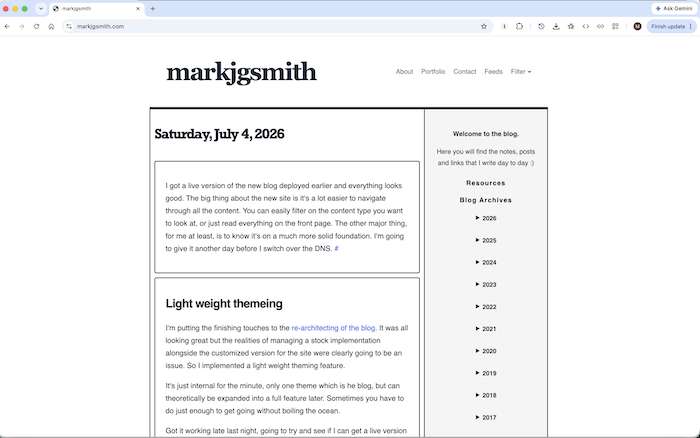
If you have been visiting the blog over the past few days you might have noticed that it has changed somewhat. I deployed the latest version a few days ago, and have been doing various tweeks and fixes. I think things are looking pretty good. The design is a lot more sleek, still minimalist and optimised for reading text. On small screens, the header is smaller to give you maximum screen real estate. It‘s mostly black text on white background, and the titles are bold, there are some black borders around content to keep he focus on the posts. It‘s crisp and clear, and since it‘s a static site, all pre-rendered, it should load really fast.
The other big thing is navigation. In the right sidebar, you will see a list of all the years of content, and you can navigate directly in there to any date and see posts. And in the header you will see a "Filter" dropdown that gives you the possibility to select to just view a specific content type, i.e. notes, posts or links, and it should switch to that content type for the specific date period you are currently looking at. I was able to do away with lots of clutter that was previously in the right sidebar, and now the most important links are in the header: About, Portfolio, Contacts and of course Feeds.
Another small tweek, the year in the footer copyright text at the bottom of the screen is automatically rendered based on the current date, so no more forgetting to manually update it and suddenly it‘s out of date. One less thing to worry about.
The thing that‘s not apparent just from looking at it is that the whole thing is rendered using my new static site generator. That‘s a massive boost in terms of robustness. The code is all in one repo and way way better written, way easier to reason about. It should be much easier to add features, without worrying about breaking things. As much as I loved the old system, and it got me very far, it had some rather rough edges. The new system is inspired by what I learnt the first time around, but it‘s a complete rewrite, with loads of new features, and a much more solid rendering pipeline. And is highly programmable.
There are still some things I need to implement, like for instance tags. You can see the tags on blog posts, but they don't link to pages that contain all posts with those tags just yet. More to write on this in the near future, but for now just happy the migration went quite smoothly, even if it was a lot of work.
This is how it looks: