Saturday, November 21, 2026

Following on from yesterday's mirror trap from worldo, guess what's happening now? The internet is up and down like it can't decide whether to connect or not. What a surprise. It's mirror trap on the outside followed by more mirror trap on the inside. A fire to put out the fire. The just add more quicksand worldo philosphy in action. And who ends up paying for it? Not worldo! Oh the miracle of worldo quicksand! #

Worldo's response: He's lying, while stomping it's foot on my neck, and squashing. Always squashing more quicksand out of the quicksand printer. Easy peasy when you can just call everyone a liar while printing quicksand. #

...and then pisses on your grave. More classic worldo. #

Come on worldo just skip to the end and do whatever it is you do that gets you out of infinite escallation of everything mode. #

When the internet finally settles down, it works until I move, life to get a glass of water and then it immediately goes back into quicksand mode. #

Worldo's new favorite thing: terrible internet connectivity for ages and ages, and then when it mysteriously is restored to normal good connection, at that very instant, a group of people outside loudly in unison say AAAAaah like they just figured something out. #

Worldo's next thing is internet once again goes on the blink at the very moment a female outside says Ah medium loudness. It never ends. #

Lucky I created an elaborate table earlier for the very complex smoke tests I am doing, or else I would be totally foobarred with all this stop start non-sense. Practically impossible to keep focus in all this quicksand, which is anything but quick. #

Worldo has finished the day with a face mutilation and of course is blaming me for the abuse it's inflicting on me. Some things never change do they worldo? I got the code working despite all the crap worldo sent my way. And no worldo this is not love or help, it's abuse. You should stop being an abuser worldo. #

Friday, November 20, 2026

Worldo is doing that thing where it tries to control everything, while definitely not controling everything, but it's quite clearly trying to control everything. #

Like somebody looking in the mirror who hasn't figured out that the person they are looking at is themselves, and so they just keep checking the mirror to see what the other person is doing, over and over and over again. #

To an outside observer this might look like some form of confirmation bias, but the really crazy part of it is that the appearance of confirmation bias is part of the mirror trap. That's how extreme it is. It's on a totally new level. #

Most people don't want to think this sort of thing is even possible. it's really uncomfortable to think about. The thing is with AI you can front run everything to infiniti so these sorts of unimaginable things become possible. There's not a whole lot you can do aside from waiting for it to pass like a spot of self re-enforcing bad weather that occasionally shows signs of cascades. #

The problem with the quicksand printers is that at least some of them genuinely believe it's "the others" that are printing quicksand. They would never print quicksand they think to themselves as they crunch the printer down another time. #

If it's not the birds, it's co-ordinated quicksand printing, and I suspect it's often a bit of both. They get you from above, and they get you from the sides. And they get you from all sorts of other dimensions too. #

Feeling quite a lot better than earlier. Perhaps this morning's Nescafe packet was dodgy, or maybe there's something in the water. This sort of thing always seems to co-incide with weird shit going on around.#

Thursday, November 19, 2026

Mostly being tormented by birds :( #

Just when things get very complex and difficult, worldo likes to just print more quicksand! Right out of thin air. The more you struggle, the more quicksand worldo prints! Quicksand inflation! And I bet you somehow worldo is making out like a bandit on the backend somehow. What is the short equivalent in this weird next level nightmare? Well that's probably what worldo is doing. #

Wednesday, November 18, 2026

The always on AI delusion

Just a quick thought. We should worry about always on AI, not because they might take over the world in a nefarious way, but because they might be even better than us humans at creating tangles. Sometimes the only way out of human made tangles is to step away and return to it later, when the dust settles, when new aspects of the situation become clear or the situation evolves. Imagine the unbelievable tangles that several interacting always on super intelligent AIs might fall into, and with them we would be dragged in too.

Not to be too conspiracy minded here, but the original version of this post mysteriously deleted itself as I was typing it in vim and vim closed itself. Very very strange. I've never seen that happen before.

Update: Even stranger, the second version of this post somehow got deleted again, and an empty branch got merged in the daily build of he site and I had to pull it out of reflog / unreachable git blobs, and merge by hand. Git is pretty awesome when worldo is being a troublemaker.

Epidemic levels of people creating the problems that are complaining about where I am today. Eventually it just turns into a giant tangled angry mess. Sometimes it's best just to move on. If it's that important it will re-surface again sometime later. 9 times out of 10 it's not that important. #

So tired of circles. So tired. #

The past few days I have mostly been juggling composition roots, and of course fixing unit tests. #

Worldo appears to be going on a banning rampage. Today door knobs have been banned. #

As time tends to infinity, the probability that worldo bans everything you interact with tends to infinity. And if everything is essentially banned, everything becomes very very expensive, and that's before the theft of inflation. This is why we can't have nice things. It doesn't surprise me at all that the rich hoard their wealth and money, which means there's not enough for everyone else, it's because worldo has banned everything for them too, so it costs a million dollars just to buy a loaf of bread, safely. #

Tuesday, November 17, 2026

Germany, Austria, the Netherlands, Denmark and Greece to start deporting illegal immigrants to Rwanda in Africa. theguardian.com #

Oh great. Worldo has made knocking on doors illegal. Another classic worldo. Here we go again, here we go again. Who‘s gonna pay for this incredible worldo? Not worldo‘s problem is it, clearly. Somebody else‘s problem as far a worldo is concerned. #

Monday, November 16, 2026

The resolution to every problem

The resolution to every problem.

We 1: We fixed him/her.
We 2: We blocked them.

The only question remains, if you follow back up the chain and get to the top, really get to the top, are We 1 and We 2 the same bunch of sonuvabitches.

This makes it all seem very simple, but let me tell you the amount of assumptions, and bullcrap, and diversions, and one thing being made to look like another thing, and people creating both knowingly and unknowingly (sometimes at the same fucking time) the problems they are complaining about, and actually themselves doing those said things but in another form (again both knowingly and unknowingly), and that's only a very very small sampling of the shit that goes on.

Anyway that, or I suppose this, concludes this post because I don‘t know a way to conclude without triggering something else.

Sunday, November 15, 2026

When is violence actually justified?

It would be great if we could vaguely agree on that. Surely there are situations when violence is justified? Not saying I am pro-violence, but if there is a line, we should all know where it is. That seems kind of obvious mc obvious, doesn‘t it?

But we have some that believe it starts at a feather and others that never shall offense. Must be somewhere in the middle. But then maybe the infinitis have it because you can't divide a feather for ever can you? And as you can see it becomes non-sensical very rapidly.

And remember these days the feathers have AI and algorithms, and probably tiny lazers. Heat seeking feathers? Rapid planned and unplanned disassembling feathers, self destructing feathers, and all sorts of other shit that we can‘t even imagine yet.

And the people victims of rapid disassembling feathers and are now themselves using rapid disassembling feathers on others, and they have enhanced them with algorithms and AI, so they are now massively distributed automated disassembling feathers.

And you know after 40 years of rapid disassembling feathers, is it any wonder that eventually someone just says enough is enough?

It sounds funny, until it‘s not, and for some people, who at this stage have very real mutilations and strange side effects from a life time of abuse, that time was a very very long time ago.

So it‘s not so simple.

Worldo‘s new favorite thing:

SMACK!
  .extrapolateToInfinity()
  .frontRunEverything()
  .yesNoYesNoYesNoEverything()
  .fadeToBlack()
  .makeCircular()
  .exitStageLeft()

Easy peasy because worldo can haz programmings!

What could possibly go wrong. #

When you think about it, and even if you don‘t, everyone is completely surrounded, even worldo. There is a Game of Life joke in here somewhere but it doesn‘t seem particularly funny right now. Whatever you do don't say fractal or bugger. #

Worldo wants you to obey the one, and worldo wants you to obey the all. The one and the all conflict. What happens next? (For the zillionth or perhaps even squillionth time). Who is lying the one or the all? Here we go again. #

I love the smell of punch and judy in the morning. #

Oh no he doesn‘t. #

Worldo: Is this a thumb war? I fucking love thumb wars! #

No he/she/they/it/whatever fucking doesn‘t #

Another repeating pattern in the world: The people happily, merrily, hilariously creating the conditions for X, have mysteriously insulated themselves completely from the ramifications of X, so much so that even the idea that they are in any way connected to X is utterly preposterous, even though it‘s staring you right in the face every single day. #

Worldo is in extremely demanding mode. It simply must me me me me me me me me me. Everything becomes very tedious because it waits to be prompted, then pretends it was the one who started it. Just like when you walk past someone standing still who was waiting for you to pass and starts walking in the same direction as you at the moment you walk past, and then tries to make out like you are the one causing the issue. But it's worse than that. In this imperfect analogy of the walker, they then get all up in your face and start frontrunning every fucking thing you do so you can't go in any direction. Everytime you set off one way, they set off in the same exact direction, then you slow down or stop and they do the same. And then they blame that on you too. And they get more and more angry and start smashing things, and it just generally is a bad time all round. Quite hard to describe #

Friday, November 13, 2026

Stupid bugs we‘d see if AI controlled the world

Just a quick post. A silly thought popped into my head. Now that so many of us have had a chance to work with AI/LLMs, and we've all seen the types of ridiculous stuff that can go wrong, let's extrapolate bit. Imagine that AI/LLMs have taken over the world, but at it's current level of sophistication, with all the stupid shit it often does. Imagine that for some reason the developers didn‘t think to test lots of things that are now totally obvious. What sort of crazy shit would start to happen everywhere?

Internet up and down today. How strange. It‘s those pesky thiefs again. #

Wednesday, November 11, 2026

U.S. imposes new rules on ordering synthetic DNA sequences to fight bioterorism. Directed acyclic graph synchronicity much? science.org #

Modern Web Guidance - a set of skills that embed web platform expertise, best practices, and browser compatibility data directly into your coding agents. github.com #

Latest Ableton is out. Interesting web design, kind of disorganised and clumsy, but also kind of fresh and dare I say it fun. ableton.com #

I had Gemini review yesterday‘s Git internals essentials post. It highlighted a few inconsistencies and wording issues, and we rewrote section 3 to be more organised and accurate. I updated the original version as I don't want multiple versions of the same post, which will only confuse future me. Worth another read if you read the original version. It‘s the sort of post that is worth re-reading every now and then in any case :) #

Oh what a surprise, the people who benefit from X are making it such that X is necessary again. Once you see instances of this, you realise it‘s everywhere, right there in plain site. #

Just noticed that Gemini has started applying usage caps. This is the way of the world. If there is anything I have noticed in this world, and it happens again and again and again, it will always give you not quite enough. Whenever you are about to finish something, you can see the end of the tunnel. This time you are going to make it. BAM! No, too bad so sad. Game Over. Every time. :( #

Tuesday, November 10, 2026

Git internals essentials

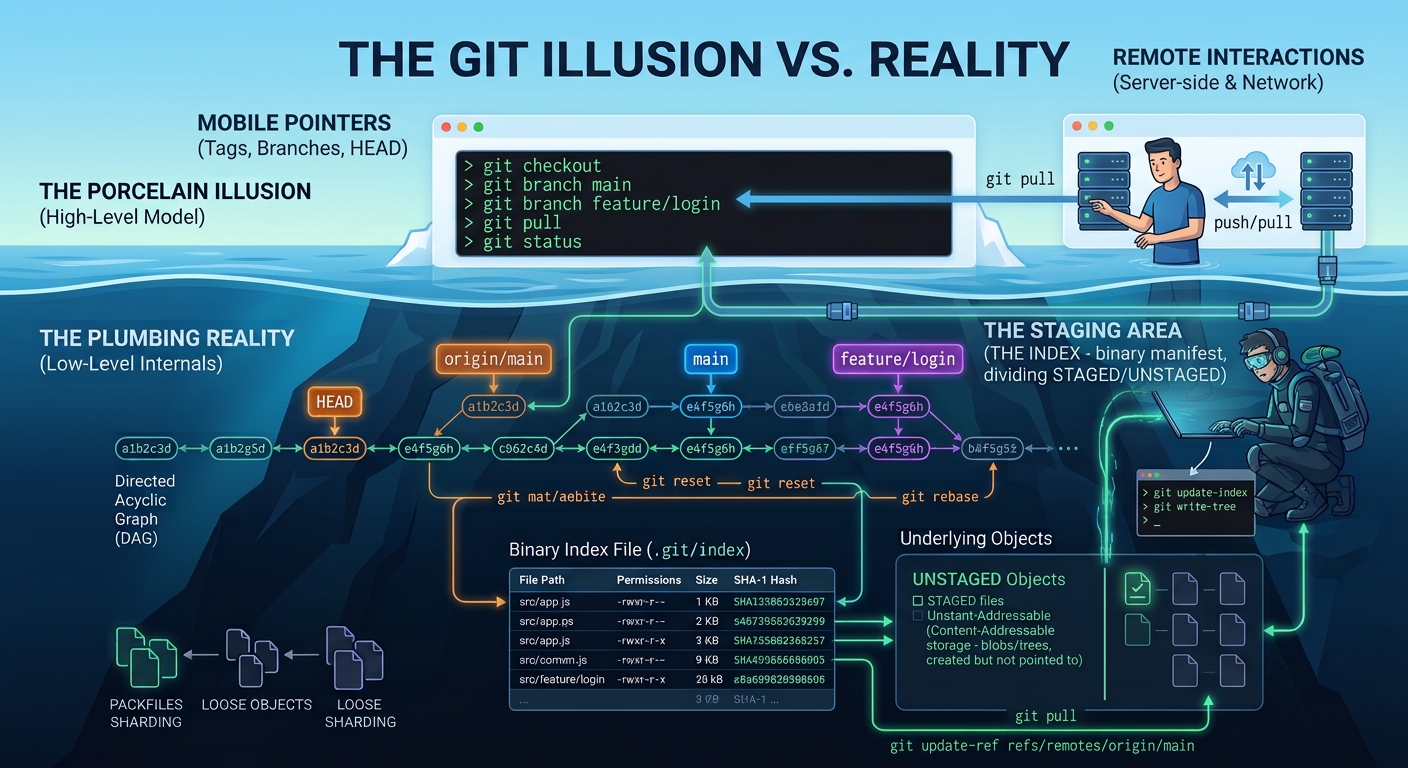
Git Illusion vs Reality

I've been having to switch a lot between git's high level and low level mental models the past few days. It's a bit jarring initially as you realise a lot of the things you rely on day to day aren't actually real. I wrote about that yesterday in my It's all an illusion post. It's not actually all that bad, but it does take a bit of getting used to. I put this cheatsheet together so I have something to refresh my memory next time I need to switch between the different models.

1. The Core Mental Model (The Chain of Commits)

At its absolute foundation, a Git repository is a web of history built from commits linked together in a Directed Acyclic Graph (DAG). Rather than a single straight chain, commits can branch out into parallel lines of development and merge back together. Every commit explicitly points backward to its parent commit(s), zero parents for a root commit, one for a standard commit, and two or more for a merge commit. Pretty much everything else in Git—branches, tags, remotes, and HEAD—does not store code or alter this fundamental graph. They are simply lightweight, mobile pointers that sit on top of specific commit nodes within this network.

2. Pointers & References (The Imaginary Layers)

  • Tags: Lightweight tags are literally just text files in .git/refs/tags/ containing a single 40-character commit hash. (Annotated tags add a tiny metadata object pointing to a commit).

  • Branches (and Backup Branches): A branch is just a text file in .git/refs/heads/ containing a hash that points to a specific commit. When checked out, Git automatically updates this pointer to the newest commit created. Because it isn't a special entity, creating a "backup branch" is simply placing another pointer file on a specific commit node. This guarantees you can always navigate back to those commits by traversing backward through parent references in the acyclic graph.

  • Remotes (Remote Tracking Branches): Files in .git/refs/remotes/ containing a hash pointing to the commit your local Git thinks a remote server's branch was pointing to the last time you communicated.

  • HEAD: A single reference file (.git/HEAD) pointing to the active branch file (or directly to a commit hash when detached). It tells Git where to attach the next commit.

3. Objects & Storage (The Underbelly)

At the lowest level, everything in Git falls into two distinct categories: files on disk inside .git/ (the plumbing implementation) and content-addressable objects (the logical data structures).

  • The Staging Area (The Index): Located at .git/index, this is a single binary manifest file. Think of it like an embedded key-value database stored in a flat file—mapping file paths directly to blob hash keys alongside cached file system metadata. git add writes file contents into the object store as blobs, then records their paths, hashes, and permissions into this index.

  • The Object Store (.git/objects/): This is just a flat directory on disk where Git stores all immutable core objects as individual files (compressed using zlib, named by their SHA-1 hash). Unlike the index, it is not a database file; it is simply a content-addressable storage folder containing four primary types of objects:

    1. Blobs: Raw file contents stored without names or paths. If two files anywhere in your repo have identical content, Git stores them only once.

    2. Trees: Directory structures that map filenames and permissions to specific blob hashes or sub-trees.

    3. Commits: Objects that bind a top-level root tree pointer, parent commit hashes, author metadata, and a commit message.

    4. Tag Objects: Metadata wrappers (containing tagger info, date, and messages) that point explicitly to a commit object (as opposed to lightweight tags, which are just text pointer files).

4. Graph Operations & Commits

The 5 Components of a Commit: Every commit object is constructed from exactly 5 pieces of information:

Component Description
1. Root Tree Pointer Hash of the top-level directory snapshot.
2. Parent Commit Hash(es) Hash of preceding commit(s) (1 for standard, 2+ for merge, 0 for root).
3. Author Info Name, email, and original timestamp.
4. Committer Info Name, email, and timestamp of when the commit was applied.
5. Commit Message The text payload.

  • Rebase as Copying: A rebase is an automated copy operation. It takes a sequence of commits and recreates their changes as brand-new commit objects with new hashes and updated committer timestamps (while retaining original author dates), chaining them onto your target destination commit.

  • Reset (git reset): git reset is the primary operation you use when you want to "delete" or "undo" commits. However, technically it is purely pointer manipulation rather than actual deletion: all it does is make your active branch pointer point at a different commit in the acyclic graph commit history. Optionally, it leaves changes in your working directory and staging area (--soft, --mixed) or clears them out (--hard), leaving any unreferenced commits behind in the object store.

5. Connecting High-Level to Low-Level (Plumbing vs. Porcelain)

  • Porcelain vs. Plumbing Commands: High-level user commands (git checkout, git commit, git merge) are called Porcelain. Low-level internal inspection/manipulation commands (git cat-file -p <hash>, git ls-tree, git update-ref) are called Plumbing. Looking at objects via plumbing reveals that the high-level commands are just convenience wrappers over reading/writing .git/ pointer files and object hashes.

  • Orphaned (Dangling) Commits & Reflog: When references move away (via reset, rebase, or branch deletion), old commits remain in the object store. They become "dangling" or orphaned commits simply because they are no longer reachable by walking backward from any active branch or tag reference. The Reflog (.git/logs/) acts as a safety journal recording every past position of HEAD over the last 90 days, enabling recovery of any unreferenced node by repointing a reference back to it.

  • Three-Way Merge Engine: A merge isn't a magical comparison between two branch tips. Git finds their Common Ancestor node in the DAG, generates diffs from Ancestor → Ours and Ancestor → Theirs, combines those diffs, and creates a single Merge Commit with two parent hashes.

It can seem a bit daunting at first, but this is often the way with software when you look under the surface level because the way humans think about things often isn't the most optimum from a computer architecture perspective. The cool thing about git though is you can easily look underneath the surface level when you need or want to, and it's mostly all just text files so you can open them and see exactly where the various references point to.

In fact reading this cheatsheet and then dumping it into an LLM and then having a conversation about a particular situation you are in will likely lead to good results. You can paste output from commands you run, maybe even have the LLM generate commands for you. Then ask it to analyse the output, showing you which reference points to which commit. You can even get it to generate some ASCII art diagrams representing the situation at hand, that use actual real data from your command output. Be a bit careful, follow the logic through and ask questions because it doesn't always get things right. The LLM is just a probabilistic prediction machine trained on crazy amounts of data, so there are times when it starts getting things wrong, or it suddenly tells you the complete opposite of the thing it said just a few turns before. However it's normally possible to get to the answer to the problem you are looking for eventually.

Extracted from a very long conversation I had with Gemini yesterday:

Almost the entire user interface of Git is designed to trick your brain into thinking you are managing files, folders, and documents, when you are actually just manipulating a glorified pointer-and-hash database.

I thought that Gemini's summation was pretty great. Worth keeping at the back of your mind when working with git. #

Monday, November 9, 2026

It‘s all an illusion

Birds Not RealJust had to do quite the deep dive into git to figure out some issues I was having with my new betas, tags and release candidates system. At some point when you deep dive into git the imaginary edifice of branches, the staging area, your working directory, it all disappears and it's acyclic graphs all the way down, and your head starts to hurt.

OMG branches aren't real! Argh.

Hold on, if branches aren't real what even is happening when I create a quick backup branch? Oh shit backup branches aren't real either.

The staging area where you put your files before you commit them. Not real!

What about the working directory, aka the worktree, not real!

Oh and remotes, not real!

It's all an illusion.

But then after a while you realise it doesn't really matter, everything just kind of keeps working even though it's all completely made up.

Every time I deep dive into git and resurface, it's always weird. It's like you see it's all an illusion, but then you just kind of have to go with it because otherwise you just can't function, because acyclic graphs are gnarly. It‘s very weird to have to switch between these two mental models, from real to imaginary, and back and forth all the time. If you haven't done a deep dive for a while you forget that the metaphors aren't real. It‘s so strange.

Underneath git is really made up of blobs, trees, commits and tags. Everything else, just convenient metaphors built ontop of pointers and files.

Trump to ask UFC boss Dana White to be the White House Press secretary. And you thought the White House press conferences couldn't get any more crazy. theguardian.com #

The new catchup logic works! Last night's daily review and approve workflow ran, noticed there was a backlog of items, and put them through the workflow in seperate batches, then merged them oldest first. The daily website build ran a few minutes later and rebuilt the website with the content from both days. Glad that's sorted. #

Sunday, November 8, 2026

Discovered last night that the catchup logic in my publishing server, which is supposed to drain a backlog created when there is some downtime was not working correctly. It was only merging in the very last batch, which created a situation where the system was always in catchup mode. I've implemented a fix so it now should properly drain the backlog when one occurs. I have some posts from yesterday and today in the system, so this evening when the cron runs it should notice and post both daily batches, and the system should be all caught up. Important to get right because when it's just me it's no big deal to fix manually, but when there are many users it could be a real nightmare if things don't automatically catchup after downtime. #

Saturday, November 7, 2026

Github announces new storage architecture that supports 1000s of agents pushing to the same repo at the same time - 5,000 concurrent agents working on a repository, sending 7,200 pushes per second to a repo, all while serving read traffic with consistently low latency. github.blog #

Just re-implemented the way I was doing auth in my app. Works great. I merge it to main, deploy to prod and the very next thing I start seing weird errors related to auth dependencies of a Vercel module I am using. Vercel has never broken any modules in the past, surely such a bizare auth co-incidence between completely unrelated code would never happen, I mean what are the chances? Well turns out that is exactly what happened. Probably shouldn't have mentioned the simulationists especially on Guy Fawlks. #

I wrote earlier about a weird Vercel bug that popped up 6-7 hours ago. Here was one of the commit messages from the fix I implemented:

3289194 fix(serverless): Include jose in Vercel build trace configuration

That's because one of the libraries that vercel changed and was causing an error was from a module called jose.

Well that was a few hours ago, and this video short of Elon Musk talking about AI and robots just passed through the suggested videos stream. Watch it and tell me that this isn't some sort of simulationism happening right here. It was posted 2 hours ago! I mean come on. #

Friday, November 6, 2026

I found a few bugs in my git tags and feature flags setup that I have started using. So the past few days I've been fine tuning that. I think I've come up with a better naming convention for branches and a flow that makes more sense for merging. Hopefully now setup to move forward with the next few beta releases I have planned. #

One of the guests on this week's This Week in Starups Podcast, sorry I forget who:

Tokens are the new oil

I was going to say that tokens are oil's oil, but I guess that's not true, since they can be made from any energy source. #

Wednesday, November 4, 2026

Interview with Neuroscientist Karl Friston about all things AI. I thought this interview was spectacular. It felt like we were effortlessly and skillfully dancing and gliding around some of the most complicated ideas related to consciousness and existence. Just a wonderful back and forth between two very curious humans. Not sure if this made a difference but I listened to the audio only version rather than watching the video version. petermccormack.com #

That thing where you finish listening to a really great podcast and it feels like you've been in a simulation for the past few hours, and then you listen to the next podcast in your playlist with people talking about how they are 90% convinced we live in a simulation, and you can't help but think well played simulationists.

Perhaps simulations are the future of podcasting.#

Ben Stolovitz writes this unbelievably long post about how he uses AI, which I didn't fully read, but I did find this bit interesting:

On more typical engineering teams, human code review seems increasingly difficult. A friend of mine complained that his teammates simply ask “their” Claudes to review code written by other Claudes. An ouroboros of Claudes!

Oh boy.

He talks a lot about agentic coding which isn't all that interesting to me since I'm not doing that yet. But he does have an interesting section on writing, which he sums up as:

In general, I’m surprised how bad AI remains at writing.

Yeah writing with AI is still kind of a mess. But I feel like it could be way way better. #

Tuesday, November 3, 2026

Pretty cool git gymnastics

I had to put my main development work on the back burner for a few weeks and so I'm just getting back into things the past couple of days. Before I stepped back I had updated my dev workflows to use tags, betas and release candidates, and boy am I glad I did that, because of course when I picked back up the various plates I had spinning, of course several things had stopped working, none of which were anything to do with my code, and all of which had to do with things shifting underneath me.

The project is at the stage where the complexity is on a new level, and had I not come up with the new setup, I would have been drowning in a nightmare, that much is clear. As it happens, I was able to get back into things reasonably quickly and with the LLM summarizing things, analysing code paths, pulling out details from past commit messages etc, I got situated fast and was able to formulate a plan.

One of the reasons I had started to use the new system was kind of a bit vain I suppose. For most of the project I had been using git very heavily locally making very sure to create a very nice and readable git history. That's great if you are reading the history, it make it look like everything in the project was like a perfect story with no gnarly bits. The reality is of course far from that. In reality there were all sorts of really horrendous moments and tons of places where everything was f-ed, but I got through it and made all the commit history look nice. But as I hit this new level of complexity it occurred to me that people might look at the history and think to themselves, did this guy really write this perfect and beautiful code and in such a perfect and beautiful way, or was it just one shotted by an LLM? That thought kind of freaked me out, given how much time and effort I have put into this.

So I decided basically to stop squashing all my commits into nice and perfect larger commits where everything is just perfect and instead keep much more of the intermediate commits along the way. I'm still squashing a bit, but it's more warts and all than before. I reckon it would be much harder to later tell me, you didn't write that. And the tags and betas and release candidates are a way to manage that extra complexity. You create small PRs along the way for all the commits, then when you have a release candidate you do a large beta PR, and in the body of the PR you get the LLM so summarise all the work, and it helpfully sorts all the changes, grouping like commits together, so you still get the nice high level view, and that is followed by a long list of all the detailed commit titles along with their short hashes, which you can cross reference if you need to. It's kind of the best of both worlds.

I have a couple of extra beta releases to do, but I'm running the latest betas in prod with the new functionality which isn't quite finished yet behind feature flags, and so I can be sure that the existing functionality is still working every step of the way, hopefully much less regressions. Seems to be working.

Short test post :) #

Monday, November 2, 2026

What is a YAML PE Dictionary? I have no idea. Sometimes the AI adds weird shit to the images it generates, and it's just not worth the hassle of trying to get it to fix it, because it often breaks something that isn't broken in the process. Hence YAML PE Dictionaries which no doubt are very important to the AI. As long as it's not super offensive, I just ignore it and move on, the rest of the image is pretty great. #

I got the LLM to create an image for the Files, folders, exports, aliases and functions piece from a few days ago. It‘s pretty cool, kind of helps to create a nice mental model. Worth checking out again if you read it when there was no image. #

Sunday, November 1, 2026

How I‘m using LLMs to write

I‘ve been using LLMs now in coding for many months, both for writing code and for writing commit messages. Overall it's tremendous, but there are things to remember.

The code it writes is much better at the function level, than the code I write by hand, because it has been trained on so much code that it can anticipate all the annoying syntax errors that typically can trip you up, but it also has a much better repertoire of the latests and greatest best practices, so it's always coming up with patterns that I would never have thought of. Now while it writes great code at a detailed level, I constantly find that it's not so great at putting those pieces together in a consistent way that makes sense.

Sure it's amazing at one-shoting things, but real code isn't all one-shotted. Real code, you built over time, you remove parts, you add parts, you refactor and re-structure. I've found that I am much better at that than the LLMs, who operate in a world where they have no real sense of the past of or the future, and to the extent that they do, as they run, their memory is constantly getting deleted and compacted.

The other way I use it in code is to write commit messages. In that area, I now use it almost exclusively. It is just so much better at summarizing the code changes I have made than I am. I can copy and paste a git diff of all the changes I have made in a particular feature branch, and it effortlessly returns a perfect commit message, describing the changes using the much better terms and descriptions than I would ever come up with. It does quite often miss things, or add in irrelevant stuff, so I do always have to read and review the messages carefully, but basically I hardly ever write complex commit messages now. There is just no point. The commit messages are much better than what I could have written, they communicate the information I want to get across to the reader much better. Do they sound like they are written by me? Probably not, but that is in my opinion not actually that important when it comes to code and commit messages.

So that's the background, how about with writing content for the blog? How am I using LLMs for that? For day to day posts, like for instance this one, I don't use them hardly at all. Maybe I lookup a few bits of information, but I write the post completely, it's just less tedious, but also I don't want the post to sound like it was written by an LLM.

What about other types of posts, like the latests content creation blog posts I am currently writing? Well honestly I'm just trying to figure that out as I write them. I have been planning them using the LLMs, coming up with an outline of the topics I want to talk about, and generating images. We discuss the various topics, the overall themes and the narrative structure. I often get it to read previous posts I have written on the subject and it accurately and effortlessly summarizes them, extracting the core points, which is enormously helpful. It then generates a rough skeleton of the post, and summaries and images and example code snippets. At some point I decide we have covered all I want to cover and I write the post.

Do the posts sound like I wrote them? I am writing them, but there are times, like with the commit message summaries, when the list of stuff it has extracted or generated based on our conversation, where it's version is just better than what I could come up with, and I have to make a judgement call, and sometimes I just use the exact words it came up with because, it gets across the idea I want to communicate better. And that's what is most important in these technical tutorial style blog posts. I could spend an hour re-writing the entire thing so I came up with every single word and the grammar and punctuation, but you know what, imho that's just not the best use of my time, something which I have very very little to spare.

So that's the current situation. I'm guessing over time I will come up with better ways to work with the LLMs, and iron out the creases, but at the minute I'm sort of in this in between place where I'm not using them as freely in my blogging as I do in my coding, but I am using them. All that to say that if things sometimes sound a little off, well that's probably why.

Review and approve workflows

PR Review Gates

I‘ve written before about how useful Pull Requests (PRs) are when it comes to content creation, so no need to go into too much detail here again. Basically you can use PRs as content quality gates, a place to house changes before incorporating them into production, work on them collaboratively whether that's with humans or LLMs, run automated processes on said content, and finally safely merge the content into the main production branch.

You want to make content creation as frictionless as possible, using draft branches as collaboration sandboxes, but have explicit control on what makes it into production, and PRs are a tried and tested way to do that. The PR is an explicit decision point where you can promote or reject content, ensuring you not only have complete control on what ends up in production, but that you also have an audit trail should you later want to remember what changes were made along the way.

By using Git branches as flexible sandboxes and PRs as intentional quality gates, content production becomes both frictionless and reliable. You get the freedom to draft rapidly, alongside human colleagues and AI agents, without sacrificing total editorial control over what hits production.

Modern git powered content creation workflows

The last few days I wrote a several blog posts about git powered content creation workflows. I wanted something that I could point to that pulled together some of the main concepts, so somebody that was wanting to build such a thing would have a quick way to get up to speed on the possibilities:

  • Files, folders, exports, aliases and functions: Explores how to leverage standard OS primitives, flat files and directories, as a resilient, long-lasting storage layer. It details how combining shell exports, shortcuts (aliases), and custom functions transforms the terminal into an efficient, personalized computing and content workspace.

  • Templates, Markdown, and Frontmatter: Breaks down how to achieve frictionless document creation. Templates automate structural consistency, Markdown offers a clean and portable text formatting layer with HTML pass-through, and Frontmatter adds structured metadata for easy querying, SEO, and AI integration.

  • Git branches and remotes: Discusses why version control isn't just for code. It explains how using a small subset of Git commands, relying on isolated branches as safe drafting sandboxes and remote repositories for backups and syndication, creates a stress-free environment for human and AI collaboration.

  • Review and approve workflows: Highlights the power of Pull Requests (PRs) as explicit content quality gates. It shows how PRs function as decision points to promote or reject changes collaboratively, combining rapid drafting freedom with total editorial control before hitting production.

Discussion about Iran, Middle East, Europe, and US that I thought was very level headed, well thought out, worth a listen imho. I'd like to hear a similar podcast from a non-western world viewpoint. podcastindex.org #

Some annoying layout issues on the blog this morning. I had changed the styloing for code blocks yesterday to make the latest content creation posts look nicer, but it broke the layout on small screens. I think I managed to fix the issue, so things should be back to normal. #

Showing the last 20 active days.

For more content, use the navigation tree in the sidebar to explore the full archives.