🚀 Latest Newsletter: Alternative Dev Culture (Issue #125) markjgsmith.com #
Sunday, July 23, 2023
Toast UI - Grid - The Grid is a powerful library with features like data editing, filtering, sorting, and more, and can be used to customize the editor or the renderer to your desired format. ui.toast.com #
Saturday, July 22, 2023
Apple slams UK surveillance-bill proposals - I feel like there is pretty much always a snooper's charter about to be unleashed on everyone. Do they keep getting struck down or is it literally just the same bit of legislation? Probably affects all social media apps, like for example Twitter DMs, but I guess maybe those aren't encrypted. How will brits communicate if all the app makers leave? bbc.com #
Wix’s new tool can create entire websites from prompts - It's important to keep aware of what the big players in personal websites development are doing, and according to Wix, the place we are heading is quite clearly AI powered tools. From tools that generate entire sites from chat prompts, with components for e-commerce, scheduling, food ordering and event ticketing, to text and content generation tools, through to image manipulation, site builder assistance and even domain name selection. It's all AI, all the time, for basically everything. techcrunch.com #
🚀 Latest Newsletter: The Crypto, AI & Synthetic Biology Trinity (Issue #124) markjgsmith.com #
The Crypto, AI & Synthetic Biology Trinity
Friday, July 21, 2023
Daily Overview: Wimbledon - I didn't get to watch any of Wimbledon this year, but I heard the tournament was on a few days ago. Got this daily overview in my inbox this morning, which publishes aerial photography of places from around the world. Made me smile a bit, remember that I'm british, and remember the time I went to Wimbledon, watched a match with a youngish Venus Williams. It was a really fun day out, even had some Pim's and of course strawberries and cream. I don't use this word very often, but it really was quite delightfull. Glad to see it's all still there, so many hours watching the coverage on the tele over the years. I used to be pretty good at tennis, long long time ago now. dailyoverview.substack.com #
Thursday, July 20, 2023
How to Use AI to Do Stuff: An Opinionated Guide - Quite a good high level summary of which AI to use for which task to get best results. Has both free and paid for options in each category. After reading this I feel like I should try out Bing and Midjourney. oneusefulthing.org #
I expect this will be rather controversial, but what the hell. Think of it as a small, slightly bizare, thought experiment.
Asians + Jews VS Blacks + Whites
What happens next? #
Wednesday, July 19, 2023
85% of AI Startups Will Be Out of Business in 3 Years, Major Investor Says - "I would say a lot of the startups today, 85% of them, will be out of business in three years. They will run out of funding. The big incumbents are going to outspend them." - IMO the way we have things setup does not appear to be fundamentally structurally sound and/or sustainable. The difficulty is we don't yet know what structurally sound and sustainable actually looks like, it's broad and complicated and looks different in different situations, yet we are trying to optimise everything into oblivion. Maybe this is where institutions need to step up their game and create a better environment for innovation. thestreet.com #
🎙Capital in the 21st Century with Allen Farrington Ep#434 (TFTC Podcast) - Listenned to this last night, and it's as interesting as the title suggests, though I will say that in places I felt the discussion was a little bit convoluted. I'm not sure what it was exactly, it's like there were way too many words being said as compared to the number of nuggets of knowledge being delivered or something. I find that happens a lot in finance. Maybe they need better metaphores. Maybe they just need to more fully understand the landscape. But that's ok, we are all learning, and they for sure know much more about it than me, and a lot of this stuff is new unchartered territory, so it's understandable. Having said that, I really liked the general approach, structure and I think this topic needs more exploration. I want to learn more about it. I want a better intuitive understanding of what capital-as-a-tool actually means. tftc.io #
Tuesday, July 18, 2023
Testing auto posts to social media
I realised this morning that I'd forgotten to update the service I use to auto post the daily links to Twitter when I moved the website from Heroku. For many months now the links haven't been getting syndicated.
I've updated the configuration with the new RSS feed url, so hopefully they will start being posted again. Previously I was just posting a daily linkblog link, but since I've been blogging more recently I decided to configure for new blog posts to also get posted. And then I figured, what the hell might as well post them all to LinkedIn as well as Twitter.
So anyway this post is just a test of that. Once published it should appear both in Twitter and LinkedIn. No support for Threads yet, though I've emailed dlvr support to ask them if they'll be adding that as an option.
SEC Accepts Blackrock's ETF Application, signaling regulatory review - Several countries outside the US have been officially allowing ETFs, which make it easier to invest in a basket of crypto assets. So far the US has been blocking the creation of these financial instruments, so this is quite big news. Especially because Blackrock is such a large organisation. Also this week, the U.S. courts have pushed back on regulators for being overly zealous going after crypto companies. They officially ruled that Ripple's token XRP is not security. Securities typically have to follow much more stringent rules, and regulators have been attempting to apply these rules to many other cryptos, effectively putting them out of business. There appears to be a break in the clouds for the crypto industry. cointelegraph.com #
Incumbents vs. Startups in the AI Race - The speed at which the large established companies have deployed AI products has been unnexpected. Historically startups have been able to out maneuver larger organisations, at least initially, because they are less encumberred by beaurocracy. That's led to a healthy diversity in the ecosystem, but the AI era appears to be unfolding somewhat differently. The startups aren't getting the chance to get a foothold. Interesting observation, it had occurred to me too. It's beyond totally crazy that 6 or 7 companies basically run most of tech. How is that sustainable on a planet with 8 billion people? blog.autopilot.fund #
A Bleak VC Outlook - There's an AI boom happening, but only a very small number of companies are benefitting. The startup ecosystem is getting decimated. I fear that this could spread to other non-tech sectors as established players essentially garner tools that make themselves invinsible, while still keeping a cut throat culture. There are many similar unsustainable large scale dynamics currently occuring, like AI eating the old websites internet, like actors being replaced by AIs etc, that could result in very broad dystopian futures. How do we avoid large scale collapse of culture? newcomer.co #
They're really not into RFK Jr over at the BBC are they? I've listenned to him on several long form podcast interviews and I thought he sounded pretty smart. A few anti-establishment views, and that might even be a good thing, but on the whole he didn't come across at all like this article describes him. I wonder why there is such an enormous disparity. It's so extreme it's almost like they know something that they can't or won't say. I guess that's how politics goes, there will likely be some scandals revealed in due course. bbc.com #
🚀 New Post: Testing auto posts to social media markjgsmith.com #
Monday, July 17, 2023
Ever notice that NATO.replace('O', 'ZI') === NATZI? Probably just a dumb coincidence. Everything boils down to debt, even the darn coincidences. #
Sunday, July 16, 2023
Lessons From a ’90s CD Collection - I have fond memories of some of the periods the author describes, mix tapes, then CDs, but I also went through a mini-disk phase as my music tastes broadenned from alt rock into electronic. When I spend a few minutes thinking about it, I'm astonished at how different everything was back then. There was no interactive world wide web, there was albums. In fact when you think about the bigger picture, bands and albums and independent record stores, and going to bars and gigs, and talking to other music lovers, quite literally music was the internet. insidehook.com #
🎙All-in Podcast Ep#137: Inflation cools, market rips, ripple/msft beat regulators, NATO summit, cocktails of youth - Another great episode, interesting macro analysis, especially as it contrasts significantly with Jeff Snider's, some crypto talk and I also found the Ukraine war coverage great, especially the wider discussion about NATO, since I want to get a better handle on what type of things these large institutions actually do. Mindboggling that they operate in some ways like a giant SaaS platform, e.g. NATO requires military "interop" with members, also that more members means more defense contracts for US military contractors. Anyway, happy Jason is back though I thought the gang held it together pretty well last week too. podcasts.google.com #
Saturday, July 15, 2023
Stars leave Oppenheimer premiere as Hollywood actors' strike called - Hollywood actors join the already striking screenwriters. Interestingly, directors aren't on strike as their association reached an agreement recently. Maybe they should make a massive crazy movie with everyone protesting and picketing, with all movie universes colliding in the biggest blockbuster extravaganza movie of all time. It could be part improv, part AI generated, part papier maché collage. Get all their custumes made in France using the new clothes repair government subsidies program. bbc.com #
Elon Musk’s new xAI company launches to ‘understand the true nature of the universe’ - I think this announcement strengthens my wild prediction that Elon is moving to the UK. What better place to figure out the universe than the birthplace of science, while also expanding his ventures across mainland Europe? theverge.com #
MediumEditor - clone of medium.com inline editor toolbar - Open source markdown editor, very customisable, vanilla javascript, no frameworks required github.com #
🚀 Latest Newsletter: Synthetic Biology Inside (Issue #123) markjgsmith.com #
Synthetic Biology Inside
Friday, July 14, 2023
AI is killing the old web, and the new web struggles to be born - There's a lot of worry in this article but I think it's for good reason. It highlights a lot of the potential pitfalls of the AI powered future we are moving towards. I like that the author makes the observation that the web has already gone through several oh-everything-is-ruined situations, but also points out why this time the downsides might actually outway the bennefits. Incidentally I'm consistently amazed at both the high quality and high quantity of the Verge's output. How do they do it? Where are the other media orgs writting on similar topics at the same level? theverge.com #
Guide to Responsive-Friendly CSS Columns - I'm conscious that latest page has been mostly styled to look good on mobile. The links in particular look quite good on mobile because the text that goes with a link tends to fill the screen, but on desktop the screen is much wider and links look kind of thin. I'm thinking to try displaying the links section in 2 or 3 columns. That way desktop users will get a similar vibe to mobile users, with content fitting snuggly without the links looking desperarely thin and wimpy. Anyway this article does a great job of describing how to accomplish that. css-tricks.com #
French to get bonus to make do and mend clothes - Of course many of the big fashion brands aren't too happy and especially fast fashion companies, but it will be interesting to see if a burst in creativity occurs as customisation and DIY become more popular in the general population. Here in asia there are way more clothes repair shops, and they're great, you can go in and give them a sketch of what you want, then a few days later you pick up your amazing creation. The numbers they mention are kind of mindboggling, with 700000 tonnes of clothes ending up in landfills every year. bbc.com #
Elon Musk's Tesla poised to launch British household electricty suppplier - Interesting time to enter the UK energy market after a couple of years of turmoil and high prices. Could be a good base to roll out services into the EU. It’s likely part of a bigger strategy because I would have thought that the UK energy market would be a bit too small to get Musk interested. Start in a place where you know the language, then expand? Wouldn't it be cool if Musk announced he was moving to the UK? Maybe he's going to buy a 3rd division football team. telegraph.co.uk #
Wednesday, July 12, 2023
Podcasts could unleash a new age of enlightenment - Really interesting piece that makes the observations that podcasts are changing how people interact, then draws some very compelling parallels with the enlightenment, which it turns out was the period where parasocial relationships emerged. It's a nice painting, I just wish I had more personal experience of the changes he speaks of, sadly though I listen to a ton of podcasts, I don't interact socially with many podcast listeners, though it's nice to hear that it's thing. wired.com #
EU Strategy to lead on Web4.0 and virtual worlds - I want government institutions to be genuinely interested in our technological future, but when I read these types of documents I just start loosing interest after 3 or 4 paragraphs. I don't know exactly what it is with them. Maybe they are too full of ridiculously abstract ideas. Maybe it's because they seem to aim to rule the entire universe. Maybe it's something else. I find it difficult to be in the same frame of mind as the authors. I'm thinking in terms of APIs, tech specs, http requests, web services and what not. They are thinking in abstract soup-ese. I don't see how these views intersect in a meaningful way. How should I be evaluating them? They aren't a service provider company, or a media company, but they also aren't a religion. They are somewhere in between. I find them confusing. ec.europa.eu #
Europe’s agenda for… not ‘the metaverse’ - This is the Politico piece that I got the previous EU commission document link from. It makes a lot more sense to me than the official document does, because the news format is well understood, we know what to expect from a media organisation. They produce a story that describes a situation. I guess I don't really understand what these government institutions produce - Also pretty sure I walked past Napoleon Bonaparte earlier, see the tweet of the day section, didn't expect to be writting that when I woke up this morning. politico.com #
Tuesday, July 11, 2023
The problem with some finance writing
This going to end up sounding kind of complainy, sorry.
I was listening to the latest Eurodollar University Podcast episode Where did it all go? It was all a lie. and it starts off with a bit describing quantitative tightening using quotes from a finance article. It perfectly illustrates the problem with many finance articles. This isn’t a hit on Eurodollar University per-se, I know he’s just quoting other people’s words, but I think this type of dynamic in financial writing is a bit endemic in the industry.
It’s worth listening to the segment first, it starts at ~00:50. It’s about the main stream view of quantitative tightening. I’ve pulled out the main steps to this logic chain:
- Quantitative easing is a way to stoke animal spirits.
- It’s the exact opposite of quantitative tightening.
- They are depressing animal spirits by pulling money out of the economy.
- The FED only directly controls short term rates.
- By selling bonds they are pushing down the price of long term securities.
I listened to this and was like, yeah sort of makes sense, but either I’ve missed something, or there is some missing information. Remember it’s delivered via audio rather than text. I guess in an ideal world I would be consuming more text, but my internet access is such that I have to do a lot offline, hence lots of podcasts.
Let’s go back over it in more detail, this illustrates vaguely my thought process as I listened:
- Quantitative easing is a way to stoke animal spirits.
- Yup high level statement, things get easier, people feel more confident, exuberant sentiment, they do more stuff, take more risk, trade more etc.
- Note they didn’t say how that was implemented.
- That would have been helpful, even if it’s obvious to many, it’s not obvious to all, especially newbies.
- So already at step 1, the very foundation of the logic chain we are missing a vital brick.
- The finance monster just took a bite out of your working memory.
- You are forced to do mental gymnastics along the lines of "ok let’s keep going, that will probably become obvious".
- It’s the exact opposite with quantitative tightening.
- Yup quantitative easing made sense, so it makes logical sense that tightening would be the exact opposite. Remember we are still doing mental gymnastics, holding that missing brick for the finance monster. We are ok but a little unstable.
- They are depressing animal spirits by pulling money out of the economy.
- That sounds good, finally we get implementation detail. But it’s not for our missing brick, it’s the implementation of the opposite of the missing brick. Ok hold on while I create even more space in memory for that. It’s f-ing with the base brick, so worst case is that you have to double the amount of memory, because you now have a logic chain with a brick and an entire separate logic chain without a brick. But the missing brick now has implementation detail, so in a way you have freed up a bit of memory but, you have to use up memory to compute that, so it’s like a little bit worse but then better as long as you can still remember how we got here. Anyway, moving on…
- The fed only directly controls short term rates.
- This appears to be completely separate from the previous logic chain, so we have to park the unstable two headed logic chain from before, heave ho.
- That was quite heavy, but it’s parked now.
- Uh oh we are getting behind now, what was this FED stuff again? Yes the FED changes rates.
- Yes indeed the FED does change interest rates, makes sense, but wait what kind of rates did they say?
- Oh no too late, no time, we’ve missed that, we’ll have to park that now too. Heave ho.
- By selling bonds they are pushing down the price of long term securities.
- Ok so we start here with a parked unstable double headed logic chain that sort of makes sense, and another parked statement about some kind of rates that also made sense but there’s a brick missing, i.e. it’s also unstable.
- Selling bonds? Hold on that’s new, yet he’s saying it as if he’s been banging on about bonds for ages. But he hasn’t. Oh ok, let’s go with it anyway assume the best.
- Why are they selling bonds? It’s totally not obvious, even though he’s pretending it is.
- And remember we are already using a shitload of memory to balance all the previous memory debt incurred.
- You need to compute it yourself.
- The writer is offloading both memory and compute onto you dear reader.
- So let’s unpark our unstable double headed logic chain from before. Heave ho.
- Rewind, remember that we are talking about quantitative tightening, which was pulling money out of the economy. Ok, right.
- So selling bonds is tightening. Ok but why?The answer I think is something like, they sell bonds, which people buy, i.e they pay for them with money they have, thus money is pulled out of the economy.
- But wait there’s more, what’s this ‘pushing down long term prices’ bit?
- Why do prices get affected?
- Oh look, again we are having to compute for the writer.
- Selling bonds probably means there are more bonds in the market. They create and sell bonds so effectively they are diluting the existing bond market. I might have this wrong, I’m not an expert.
- The overall market is bigger, i.e. it’s size is inflated, so the bonds that were originally there are worth less.
- Why don’t they just say it’s bond inflation? Same as money inflation. Why are we constantly describing similar things using different mental models? Anyway…
- Oh look and just to confuse us even more, the writer is now calling them both bonds and long term securities. They are the same thing. You have to compute that too.
A finance explanation that uses up so much tech debt doing the explanation that it’s basically impossible to quickly understand the issue because the writer has used up all your memory and compute.
Oh the irony, an explanation of how the economy avoids bankruptcy, is itself doing a very effective job of bankrupting the minds of the people it’s teaching.
It’s basically a fractal, at which point I’m out. Fuck this this shit, it’s probably best to just walk away and listen to something else.
I say all this knowing that this article that I’m writing is kind of slap dash. I don’t have the time or resources to spend editing it until it’s perfect in every dimension. I’m sorry about that. I’m learning too. I guess my gripe is that a lot of finance articles have similar issues. It’s weird to me that no one else is complaining.
I’m left wondering how different the world would be if the explanations were better. At a macro level don’t these types of explanation just restrict the total number of people that can learn about how finance works? The total compute capacity of humans is likely finite without adding more neurons. Are people doing this on purpose or are we just terrible at explanations?
Is it any wonder the world has issues understanding money, if we can’t even balance the books explaining the thing, how are we ever going to balance the books doing the actual thing?
Nicer looking linkblog
When I migrated the website from Heroku there were so many things that needed to be done. It was pretty much a complete site rebuild. At the time my driving thought was to get the basics right, or at least mostly right. With a good foundation I could make things better over time. Some of the big things were:
- jamstack with github workflows
- single domain rather than multiple subdomains
- all content in markdown files rather than json files
- server side components
There were loads of others. When I was laying out the HTML, I wanted the site to use latest HTML5 tags and best practices, and I also wanted the whole site to at least look pretty good with a small amount of inline CSS. I spent ages trying to figure a way to organise <main>, <article>, and <section> tags that made sense. It's not that obvious when you get into the details.
A blog post is an article for sure, but what about a day on the linkblog? What about a single linkbkog link? What about the blog/podcast/newsletter listing pages, is each entry an article? And what about the latest page, should I even bother with article tags there, maybe just use regular unnordered lists? Should I nest articles?
So many small details that can actually make a lot of difference. Initially I went a bit overboard on unnordered lists. I had <ul>’s basically everywhere. Lists of blog posts, lists of links, lists of everything. The nice thing about lists is you get a small amount of visual structure and spacing for free, especially if you sprinkle some <p> tags in the right places. I figured I could style the lists later with CSS to make everything look better.
I don't know that I've gotten it right or even mostly right yet, though it feels like I'm making progress.
Anyway one place that's been bugging me was the main linkblog page. I initially went with a list of lists approach. A list of days, with each day containing a list of links. It worked reasonably well, though the bullets change on each indentation level. Level 1 has normal looking bullets, circular whole black dots. But level 2 they are hollow, with the center of the black dots removed. They look wierd. The indentation also looks kind of bad on mobile devices, because you waste a lot of the valuable screen real estate on the left side of the screen.
Here's what it looked like:
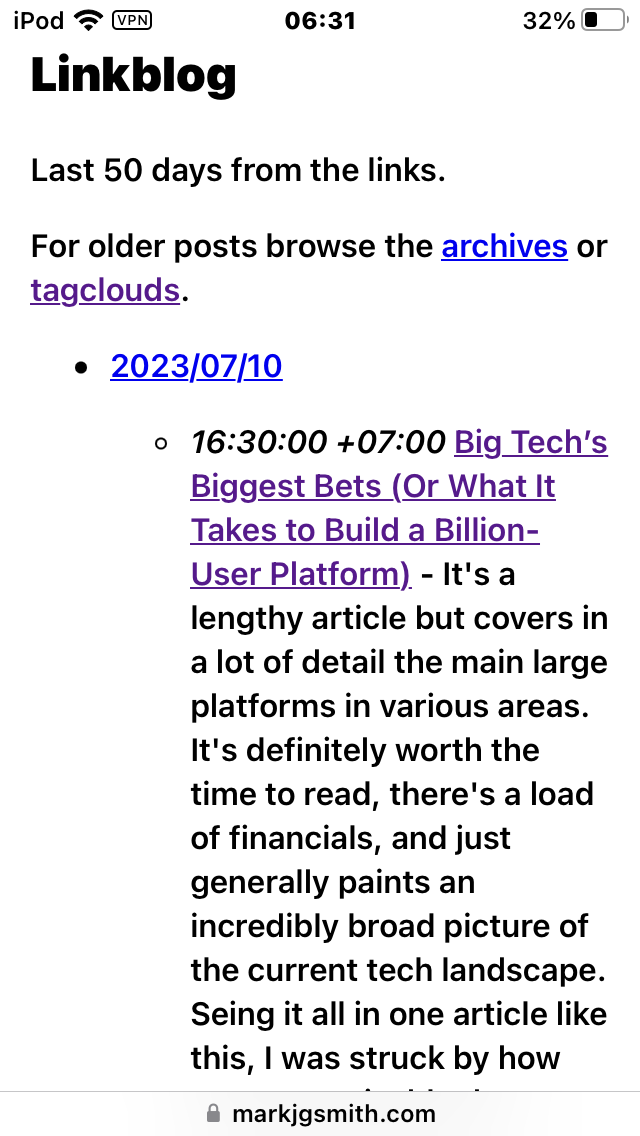
I've been trying to style the lists for a while now. I never got it looking good. The styles weren't applying the way I wanted. I would style the outer list, and the inner list would also get styled, or the opposite way around, even though I was targetting different class names. Lots of finicketty stuff like that. I gave up eventually, figured it was good enough, I had more important things to worry about and get right.
Anyhow it occurred to me yesterday to just ditch the outer list. Instead just have a load of <articles> items on the page, each one still containing a list of links. I wonderred what the default spacing would look like. Well it was a quick change to remove the outer list, tried it last night, and it worked wonderfully.
Here's the updated linkblog page:
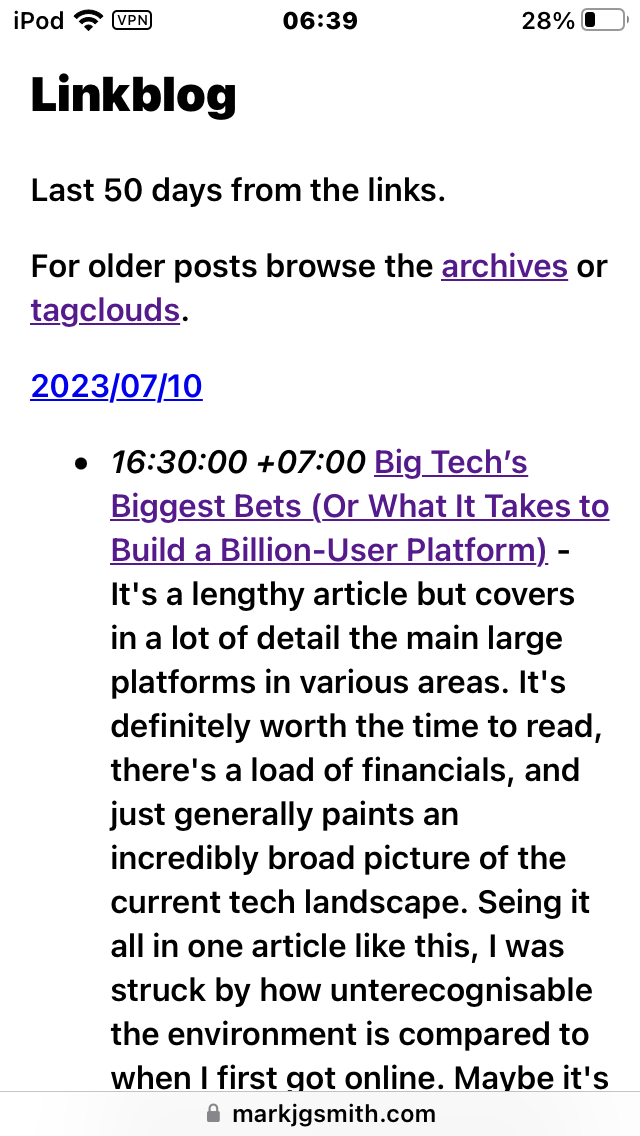
Ok so yeah it looks like a very minimal change, but I think that looks way better. I still get the structure, spacing and indentation of the bulletted lists for the links, but less wasted space and only one type of bullet point. I know the whole site is still too minimalist, but broadly speaking it's way easier to read, with the day dates snug on the left. It definitely is way easier to read on mobile, and these days that's how most people read the web.
Jeremy Hunt to unveil pension fund reform plan to help UK startups - UK pensions funds which are the largest in europe, worth around £2 trillion, could be restructured doubling the portion of them that is invested into private investments which include startups. It could unlock up to £70 billion of extra investment. theguardian.com #
Will gold pave the yellow BRICS road? - Brazil, Russia, India, China, and South Africa are thinking to club together and create a gold backed currency to rival the US dollar. What's more, around 1/2 of the G20 countries have expressed interest in joining. Why are they doing this and could it actually work? jameslavish.substack.com #
🚀 New Post: The problem with some finance writing markjgsmith.com #
🚀 New Post: Nicer looking linkblog markjgsmith.com #
Monday, July 10, 2023
Ukranian, belarussian and russian tennis players at Wimbledon and the French Open are refusing to shake hands before matches and it's causing a lot of confused reactions from the crowd, who are not understansing who is snubbing who, and sometimes getting it totally backwards. Life is such a complicated mess sometimes. bbc.com #
How to Verify your Domain on Nostr and Bluesky - These are instructions for micro.blog users but the general idea is similar on any domain, just create a text file in a specific location on your site. It has to contain some string of text the social media site gives you. Then they can check it's your domain, because you had enough access to add the file, at which point they add a verified check to your account. I think this should be the way Threads and Twitter should do verification. It feels like the "Open web" way of doing verification. At least have it as an option, they might find even more people sign up for the paid verifications. mattlangford.com #
How to Get Verified on Threads - You can do it through your Instagram account, or through Meta/Threads where you have to get on a paid plan. beebom.com #
Big Tech’s Biggest Bets (Or What It Takes to Build a Billion-User Platform) - It's a lengthy article but covers in a lot of detail the main large platforms in various areas. It's definitely worth the time to read, there's a load of financials, and just generally paints an incredibly broad picture of the current tech landscape. Seing it all in one article like this, I was struck by how unterecognisable the environment is compared to when I first got online. Maybe it's because I'm feeling particularly low energy today, but I just wanted to get through the article and found a lot of it unbelievably dull, though it's a well written article. I like the Android, iOS, SpaceX, OpenAI and a bit of the AR/VR coverage, but Alexa, gamming and everything else is super boring and tedious. I'm left wondering if I even am interested in more than about 20-30% of the tech industry. It's like a wonderful beautiful garden has been 80% turned into multi-level carparks. I guess technically they are ecosystems, they just sound and feel a bit lifeless to me. matthewball.vc #
"Caches is a web3 authenticated multi-topic forum on all subjects related to the Ethereum protocol, Web3, Science and Technology. Caches is hosted, created and curated by community members" - Sounds kinda cool, you have to have a crypto wallet installed but you don't need to have a balance, it's just for auth. caches.xyz #
Sunday, July 9, 2023
Final destination mutilation

Just another final destination mutilation. Hate to say it but, I told you it would happen again literally yesterday. It always does. This time it involved a ring, questionable soup and a piece of floor bread, but had been building over several days.
Thanks world, you win again, most cowardly punch in the universe.
FYI, I literally asked for world peace.
🚀 New Post: Final destination mutilation markjgsmith.com #
Saturday, July 8, 2023
🚀 Latest Newsletter: Pandemonium in cyberspace (Issue #122) markjgsmith.com #
Tech debt metaphor maximalism - It's definitely a very effective metaphor, really well written article too. Also, if you've got a good instinct for tech debt, might be a good thing to read to get a handle on financial matters. The thing that strikes me is how much all this stuff is like serious voodoo magic, and how terribly risky some of it is. It feels so risky to me in fact that I feel I should mention that you read it at your own risk, same for any content I write or point you towards, but I'm making that explicit for this particular linked article, which like I said is rather excellent. apenwarr.ca #
Pandemonium in cyberspace
Friday, July 7, 2023
Hello HN bloggers
Just a quick post to say hi to any folks that might have made their way here from hacker news. Howdy :)
From the linkblog:
Hacker News Blogroll - Someone on HN decided to compile a big list of people's blogs, and they turned it into a website. Someone else created a giant OPML file with all the blog feeds, and I imported the whole thing into my Feedly. It's a bizare sort of mayhem now in my feedly, I've seen english, russian, german and vietnamese posts pass by so far. It's nice to not require an invite, even if it's quite confusing :)
I'm Mark, web developer, blogger, sometimes traveller. More about me on the about page.
I haven't had a lot of time yet to read through the 692 (!) blogs I added to my RSS reader. Hopefully I'll have time over the weekend.
Welcome to the blog, I don't have comments but I read emails, so feel free to mail in comments.
Bulk importing the HN bloggers OPML
Following on from importing the HN bloggers OPML file, figured I'd quickly document the process.
Here are some screenshots of what that looked like:
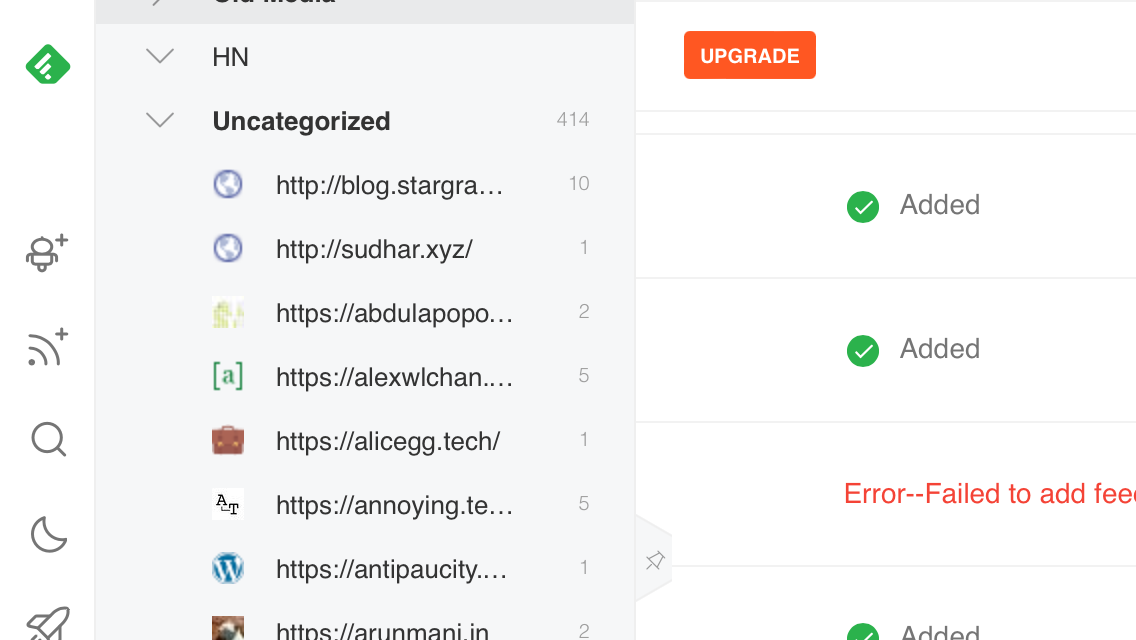
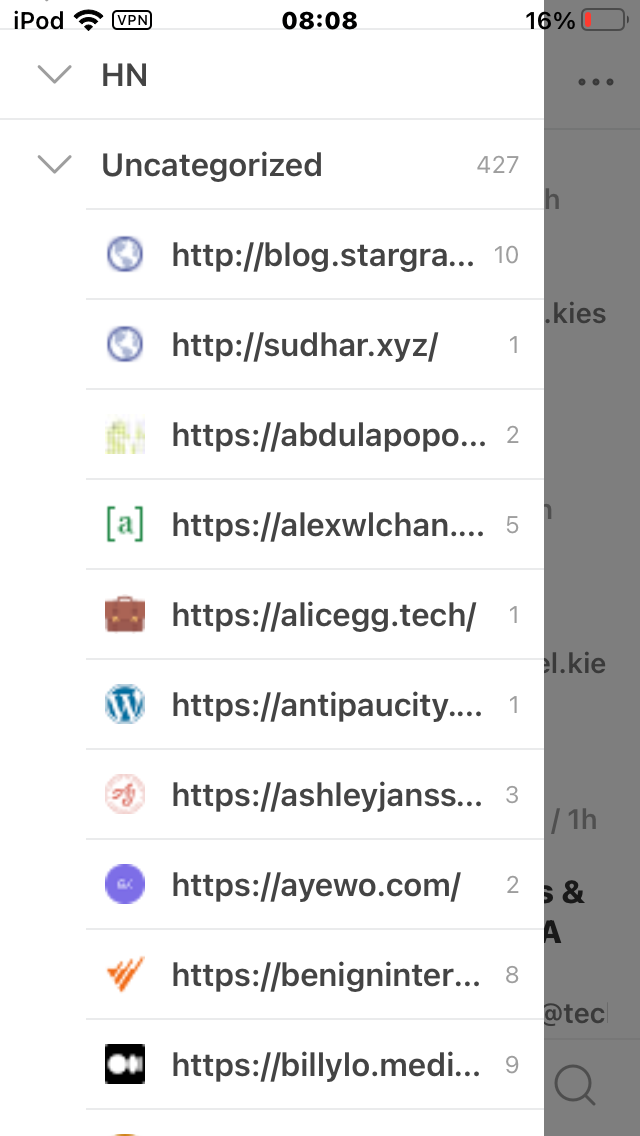
A little bit tricky to do from a mobile device. The import OPML button was only just visible on the screen, and didn't appear at all in the iOS app. Importing took a really long time, around 30 mins. I had to restart the import several times, which was a bit annoying, but at least it was clever enough to not add duplicates. Lots and lots of errors, I guess many of feeds didn't validate, or got incorrectly added to the list.
Once all 692 feeds were imported, here's what the combined feed looked like:
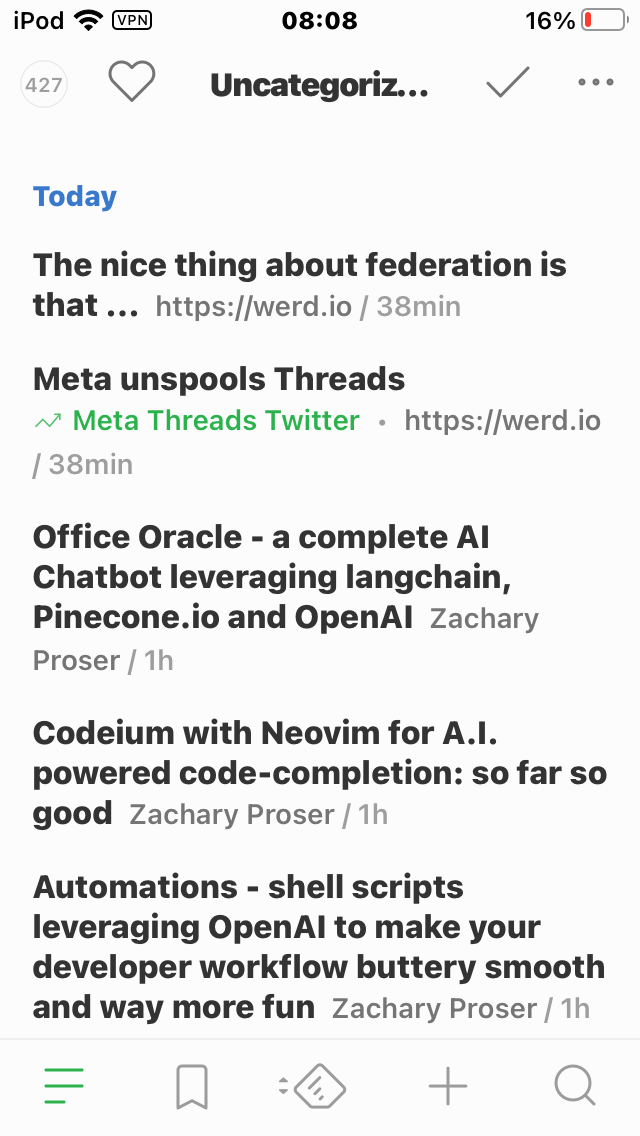



The bulk import via OPML is nice but the ability to subscribe to an OPML file would be better. That way when the OPML file gets updated, whichbit likely will, the combined feed in Feedly would stay up to date. Why isn't that a standard feature of RSS readers at this stage?
I haven't had much of a chance to read through many blogs yet. I've been busy getting multi-paragraph linkless linkblog posts working for my static site generator. Oh and installing Meta's new Threads app.
Anyhow it's cool that we have RSS. It's cool that it's permissionless, that you don't need an invite, but I'm OK with having other social media apps too. It's good to have variety, each one has a distinct vibe.
🚀 New Post: Hello HN Bloggers - Saying hi to the folks that might have made their way here via the hacker news big list of blogs someone put together over the last few days. markjgsmith.com #
🚀 New Post: Bulk importing the HN bloggers OPML - Documenting my experience bulk importing the HN bloggers OPML into Feedly, wondering why I can't dynamically subscribe to an OPML file of blog feeds. markjgsmith.com #
Wagner boss Prigozhin is in Russia, Belarus ruler Alexander Lukashenko says - I met a Prigozhin doppleganger last week, it's such a strange world sometimes, the seamingly most improbable things happen all the time. This whole mutiny story is kind of wild too. bbc.com #
Thursday, July 6, 2023
Writing as a form of thinking - The author makes the point that in this day and age of AIs that can create text on demand, that it's important to remember that the act of writing is itself a tool for thoroughly digesting and exploring an idea, a thought. He describes his writing habbits, particularly note taking. I tend to agree with him. I too take a lot of notes, especially when listening to podcasts. It's suprisingly difficult to get right. There's a big variety, sometimes it's straight forward and you take just the right amount, with a nice structure. More often you either end up taking way too many, especially when the information density is very high, or when the conversation you are listening to jumps around a lot and doesn't have a very clear structure, every bullet point ends up being top level, and there's isn't enough structure. Other times it's best just to put the pen down and listen without breaking the flow. I bet in the future AIs will monitor our thoughts as we consume media, and be able to give us a summary report afterwards with relevant links we made along the way to items in our life, and references to stuff we wanted more clarification on. Can you imagine how unbelievably cool that would be? But also kind of scary. lopespm.github.io #
Hacker News Blogroll - Someone on HN decided to compile a big list of people's blogs, and they turned it into a website. Someone else created a giant OPML file with all the blog feeds, and I imported the whole thing into my Feedly. It's a bizare sort of mayhem now in my feedly, I've seen english, russian, german and vietnamese posts pass by so far. It's nice to not require an invite, even if it's quite confusing :) dm.hn #
Wednesday, July 5, 2023
Microsoft unveils the world’s first analogue optical computer to solve optimisation problems - This is pretty cool. It's a rack mounted computer that uses streams of photons hitting a grid of modulators to perform basic matrix calculations at light speed. Initially they are using it to solve optimisation problems in bank settlements, but I guess it could be used for many optimizatiom problems. Maybe also AI? There's a lot of matrix calculations in AI as far as I understand. I feel it's worth mentioning, beware of over-optimisation. Technology is inherently deflationary, at a macro level you need to ensure you still have innovation, don't optimise the people away. There's no sense in being the best at shrinking the pie. An optimization mania could cause more problems than it solves. And I think emerging / developing economies are probably most at risk given the pressures they are under. Also worth thinking about: optimization neutrality and equality, because it's the sort if thing that could very well be weaponised. interestingengineering.com #
France riots: 'For the politicians we are nothing' - I've been reading some of the flow of news from the french riots coverage these past few days. It's such a complicated situation. I stand alongside the marginalised, it's crushing to hear that the youth have no prospects, that society has stratisfied. I spent a long time growing up in Belgium which had problems of a similar vibe, so I really feel for the communities. When I moved back to the UK, in London I experienced the british equivalent, first at a distance, then living in Hackney and Whitechappel. Though I very literally feel sad about it, I'm hopeful because I've also experienced what it's like when it works, moments when the communities were well integrated, when we were together, some incredibly magical moments. I think we can overcome the troubles, let's continue to make increadible art about the sometimes difficult realities, that's how we get through this together. We did it in the UK in the 80s with punk rock breaking through a horribly stratosphered society, then reaggae, ska, and later electronic music. Even if you aren't a fan of those genres, think of the importance of integrating the communities for the youth. That's what art does, it finds a way to bring us together. And we can do it again in whatever way we'll find this time. Having said that these past few years I've travelled the world and I've also experienced some bad things, so I know it's not all optimism, there are real concerns on all sides. Here in Vietnam it's an odd mix, because of the history of both french and english speaking influence, but also they have their own generational challenges, combined with relatively recent memories of war. Anyway, we need more innovation, more art, more building things together, and we need to grow the pie for everyone. bbc.com #
France riots: Nanterre rocked by killing and unrest - One more french riots link to say I've felt somewhat self conscious of my use of rocket emojis next to personal links to blog posts, podcasts and newsletters, given how much the riots coverage has been banging on about the prevailing use of rockets by the protestors. The origin story of my rocket emojis is 100% linked to the idea of launching towards orbit, and nothing at all to do with weapons. That thought hadn't even crossed my mind. Honestly I never even thought about it much more than just oh-launching-rockets-into-the-sky-is-cool. When I got online I was really into Rocketboom, still one of the best videoblogs that ever was, which was zero about war, and everything to do with making things, and building online and real life communities. When I think of rockets, I think of Rocketboom, a world of possibilities. Anyway I'm probably being overly paranoid. In any case, I'm gonna keep launching rockets, the ones I use are strickly amazing non violent rockets. bbc.com #
A little experiment inspired by a ghost of parasocial past, so to speak, no animosity intended, quite the opposite in fact. I remembered that a while back I added the ability to make linkblog posts without urls. I know that might seem a little bit ridiculous at first glance, please bear with me. #
Since adding the url-less links feature, a lot has changed, the biggest thing being full markdown and EJS support in link text, which makes it possible to add hyperlinks and also insert data from various sources like for instance frontmatter, here's the date from this post's frontmatter: <%= date %>.
And this is a second paragraph on this post. It's the thing I'm most curious about. Will it break the page rendering? #
Well linkless posts are sort of working 1/2 working. There is no url domain link (that's good), but there's also no hash link (not so good), and also paragraphs currently get removed (not so good). I have to think about this a bit more.
Update: I got paragraphs working :) #
Incidentally I managed to get workflows triggering workflows between repositories. What that means is that the website now gets automatically rebuilt when I merge new content into the main branch. Practically speaking it's pretty huge for me because it aleviates some of the frustration I've been experiencing from really slow github repo interaction, which I think is because there are over 15000 source files and the client is not able to handle it. Hopefully I'll be adding a new entry to my minimals selection soon, the minimal works on private repos, just need to find time to test it on public repos. #
Monday, July 3, 2023
All the feels - A classic @gapingvoid. It occurs to me as I write this that perhaps Hugh doesn't make all his own art anymore now that he's become rather successful. Reguardless the piece is great. People do operate on the level of feelings rather than the level of facts. I love the right hand image, that's totally how I feel a lot of the time, blobs of colour, sguigley bits, that's when it's interesting. It's even better when we are helping each other paint each other's pictures. Time flies. I love the idea that large companies can still create that kind of vibe. How about bigger entities like cities? Countries? I reckon they can too. gapingvoid.com #
Bluesky halts signups, can't handle the influx from Twitter - Where are all these people getting their invites? Feel like I got on the waiting list weeks and weeks ago, still no invite in the mail. That's what 20 years of participating for free on the open web gets you. theverge.com #
Unique transition between grid and list views - I'm having a terrible time getting through the CSS for this offline, but I was able to view their demo earlier when I was online, and the effect is super cool, the sort of thing you might expect in an TV advert or perhaps a native app, but definitely not a webapp. I want my blog to have something like this, and wouldn't it be awesome in 3D on the Vision Pro? wannabedev.io #
Twitter appears to be self-DDOSing itself - Some conflicting reports, but the recent rate limiting looks to be causing the Twitter client to DDOS itself. This isn't a good sign is it. I did say in last week's newsletter that the world was heading towards a blocking frenzy. I hope everyone has food and water. waxy.org #
Why Apple's Visio Pro will change movie watching - Om went to watch the new Wes Andersen movie at a theater and describes the experience. He then wonders if the Vision Pro will become the next big tech for movie watching. I'm not opposed to it, though I like going to the cinema. The more I imagine watching a movie on a Vision Pro, the more I think I might have a bit of a phobia. Whenever I think about having little screens a centimeter from my eye balls for multiple hours, I get mild anxiety. Btw I've never tried any of these AR/VR products. om.co #
Social RSS - Chris Coyier comments on David Pierce's Who killed Google Reader? article: "I don’t think I’ve seen a solid feed reader + social network take since those days." chriscoyier.net #
Uncensored Chatbots Provoke a Fracas Over Free Speech - I read this and I nod my head, but I can't help think this is just the very beguining, this is unbelievable mild compared to what is ahead. nytimes.com #
Apple forced to make major cuts to Vision Pro headset production plans - They had previously forcast 1 million units in the first 12 months, but the chinese company contracted to fabricate the device has said Apple only ordered 400000 units for the first year, with other parts suppliers reporting they have only been asked for enough for 150000 units. Apple has sited difficulties in scaling the supply chain. ft.com #
The Reddit moderators that coordinate many celebrity AMAs will no longer do so - This is such a shame, these mods actually appear to be supportive of Reddit, and haven't been participating in the protests, but they are caught in the situation nonetheless because the new prices make it unnafordable. AMAs are one of the most popular things that Reddit had produced to date. What a terrible, tragic and toxic situation. theverge.com #
Sunday, July 2, 2023
Euclid: Europe ready to launch dark matter and dark energy telescope into space - The super high precision telescope will be able to determine where all the missing stuff is in the universe. According to measurements we have made to date, measurements of the distortion to light arriving to earth from far away, everything we see in the universe, all the planets, moons, stars and billions of galaxies only accounts for about 5% of the mass and energy of the entire universe. It might even turn out that dark energy is a 5th force, one that only operates at enormous scales. Doesn't that sound earie? What in the universe would cause such a thing? bbc.com #
Twitter temporarily restricts number of tweets users can see - Following on from the news earlier about Twitter forcing login to view tweets, now there are reports of user quotas, 500 tweets per day for unverified accounts, 10000 tweets per day for verified (i.e. paying) accounts. If it really is just to combat scraping by AI training companies, why isn't regular rate limiting not enough? Does he expect literally everyone in the future to be training AIs? I suppose that is a possibility. bbc.com #
Linda Yaccarino's vision for Twitter2.0 emerges - The new Twitter CEO, who previously headed advertizing at NBCUniversal, has announced plans for full screen video ads, a new digital wallet, and gaining back advertisers trust by focussing on brand safety, as well as business partnerships with large companies like Google, Amazon, Salesforce, and IBM. I hope they don't forget about the small fish, indie Twitter seems such a long time ago now. arstechnica.com #
Saturday, July 1, 2023
Moving on - Doc Searls' blog is being unnexpectedly shut down. Doc was one of the first people I started reading and listening to online back in the early 2000s. He wrote much about Linux and open source, and was on quite a lot of the early tech podcasts. Looks like he'll be able to move his stuff over to his old domain. I’m glad he has some friends that can help him. It's not much fun being booted out. Best of luck with the move. [internet archive version] Update: He ended up at doc.searls.com. blogs.harvard.edu #
Twitter has started blocking unregistered users - I noticed this earlier, didn't think much of it, I was busy doing other things, waiting for extremely slow git push/pull or branch switch. Thought to myself oh here we go again world, now you're blocking Twitter too? Anyhow, hope Elon finds a way to undo because what's the point in posting there if everything is annexed behind a login, might as well just use WhatsApp. Yuk. theverge.com #
Introducing the MDN Playground: Bring your code to life! - A new tool to host, collaborate on and share HTML/JS/JS code snippets. There are several of these tools online but it totally makes sense for MDN to have their own one. developer.mozilla.org #
🚀 Latest Newsletter: Offline in a Digital Asset Economy (Issue #121) markjgsmith.com #
Offline in a Digital Asset Economy
Showing the last 22 active days.