markjgsmith

2023/06/30

Building digital asset economies

Dominic Frisby had an interesting episode on his Flying Frisby Podcast this week. It was an interview with Microstrategy CEO Michael Saylor. Saylor has made a name for himself initially by successfully running a publically traded software company for over 20 years, but more recently for his rather adventurous corporate investments in Bitcoin, something made possible by focussing on fair value rather than GAP accouting.

Microstrategy holds some of the largest amounts of Bitcoin worldwide, and has quadrupled in value by taking Bitcoin onto it's balance sheet despite the volatility. Most organisations haven't been willing to do that due to gap accounting practices which don't differentiate between gains due to operation and those due to balance sheet changes, for instance appreciation in commodity assets. Gap accounting companies run the risk of big volatility swings in Bitcoin's value eclipsing otherwise normal operations, making a company's performance look much worse than it appears.

Saylor is a Bitcoin promoter, given his holdings that much is clear, but the narratives he pushes are very well thought out, always attempting to be rooted in fundamentals. One of the narratives he has been putting forward recently, and which seems to be catching on, is that of building digital asset economies. He believes this is something that countries around the world are going to be getting into in the near term. And with the recent announcement of many large TradFi companies (Blackrock, Fidelity, Citadel, Schwab and Deutchebank) creating various flavours of Bitcoin ETFs, it does indeed seem to be trending in that direction. Multinational corporations need to park their money somewhere, and given the prospects of the US bond market, that place might very well be Bitcoin.

In the interview he notes how it’s important to distinguish between the different digital asset classes. Regulation takes time to evolve and people are only starting to understand the difference between these. Namely the difference between:

  • Digital commodities
  • Digital securities
  • Digital currencies
  • Digital tokens

I've transposed his definitions here, as I think they are useful, even if they haven't been fully endorsed by regulators yet, because they paint a very clear picture of the future financial environment that crypto and bitcoin proponents envisage.

Digital commodities

  • Assets without an issuer
  • Like Bitcoin

Digital security

  • Assets with an issuer, a controlling body creates the currency and they control it
  • Like Solana
  • Like Algorand

Digital currency

  • Stable coins, they proport to be the US dollar as a bearer instrument and a digital asset, a blockchain representation of dollars
  • Like Circle
  • Like Tether

Digital tokens

  • Like an NFT, piece of art 1 of 1
  • Like a Tom Brady coin, 10000 super fans coins that he issues, holders get to for example come to his house for a BBQ every month

Saylor then outlines the growing importance of distinguishing these:

A digital exchange is something that can trade all these things. To create a digital asset industry in your country's economy you have to have a universally accepted taxonomy of digital assets, a digital asset framework and political consensus that it’s ok to issue, trade and custody those assets.

We don’t currently have the political consensus for many things. There is a big divide. Saylor gives several very specific examples that help to illustrate the sea change that decentralised finance is bringing to the table.

  • Moving 1 million dollars from A to B without KYC would be considered money laundering in TradFi
  • Trading a security 24/7
  • Self custody a million dollars of digital assets in stable coin from an android phone
  • Self custody a million dollars of Apple stock on an android phone in India
  • Trade with a counter party that you don’t know via smart contract
  • Buy a perpetual swap derivative on a Saturday night that represents a registered public company
  • A person living in India that has 10 million dollars of Apple stock, borrowing against that from any counter party in the world on a Saturday afternoon, getting the best bid

All these things and much more are totally possible with DeFi. It's going to be interesting to watch how this evolves.

2023/06/29

Revisiting Instapaper for offline reading

Following on from Monday's piece about the issues reading web development content offline with Safari Reading Lists and Pocket, I wondered again about Instapaper. I had previously tried it but gave up after getting frustrated with the experience. There was a lot going on last time I tried it. I was having to jump around between apps, and was also in a bit of a rush. It's easy to get lost in a sea of features sometimes. Was the overall app experience really as bad as I remembered?

I re-opened the app to have another look. The default screen on opening the app is the saved article list. The first thing I noticed was that it just sort of looks a bit classier than Pocket's listing page. The title font and the layout of each item results in a vaguely newspaperish vibe. The content just seems to fit the available space a bit better. There are both titles and descriptions and less white space around the thumbnails. The article titles all seemed to be correct too. When an item does get saved, it looks kind of nice. I decided to give Instapaper another try.

Let’s look at the same screenshots:

Top of page - Reading Lists
Top of page - Pocket
Top of page - Instapaper

As with the Pocket, the article saved in Instapaper has most of the page styling removed. It looks much the same as Pocket’s version. The site’s style is lost but the page is still readable. I guess some folks like the consistency. Personally I prefer being able to see the original website styling.

Logical Properties & Layout - Reading Lists
Logical Properties & Layout - Pocket
Logical Properties & Layout - Instapaper

As with Pocket, the article saved in Instapaper is missing images. In fact it’s a bit worse because literally all the images are missing. It’s already game over as far as learning CSS. There’s not much point continuing to read the article. But let’s continue for the sake of comparison.

Code Snippets - Reading Lists
Code Snippets - Pocket
Code Snippets - Instapaper

Code snippets are looking better than in Pocket. At least the newlines haven’t been removed, but syntax highlighting has, and that has exposed the style hint meant only to inform the syntax highlighter what language is being used (CSS in this case). Readable but looks kind of ugly. An entire article full of these would be a real slog to get through. Syntax highlighting really makes a big difference when trying to comprehend code.

Article listing - Reading Lists
Article listing - Pocket
Article listing - Instapaper

The listing page for Instapaper looks pretty good, though notice it’s still “downloading”. That never completed by the way, nice though it is to have a progress indicator. I don’t have a screenshot of my Bitcoin article, but the title did get correctly saved. So it seems Instapaper has the better webpage parser, or at least it works better with my website.

Article page - Reading Lists
Article page - Pocket
Article page - Instapaper

The article page for Instapaper is very similar to that of Pocket’s, though I think I prefer Pocket’s version, less wasted space. But as previously described, Pocket gets the title wrong, at least for my website.

The overall Instapaper experience is better than I remember but the following issues are still there:

  • Images still missing much of the time
  • Code snippets are there and readable, but look weird, no syntax highlighting
  • You can’t copy and paste article titles on an article page, that’s really annoying
  • When images do get saved, there is no way to zoom, so anything with detail is unreadable

This time I figured out how to ensure the Instapaper icon always appeared in the Share Sheet. That’s the box with the arrow emerging from it that you tap to share things throughout iOS. I think of it as the share button, no idea why they call it Share Sheet. Previously it was there sometimes, other times it wasn’t. I installed the bookmarklet too, very difficult installation procedure, and I found it didn’t always work. There was a 3rd way to post via email, which might be useful but it wanted access to my contacts and I’ve had bad experiences with that.

The thing that struck me was how confusing setup was. That’s what got me last time. It never felt like I got to a safe place during setup. Even after completing setup it still felt like there were two many ways to post and when it didn’t work I wasn’t sure if it was me, or the setup, or iOS config. Eventually I gave up.

I’ve been using Instapaper for a few days now, and for non-web development content it’s actually quite decent. The item download indicator is the biggest improvement over Pocket. The classier look is a big draw too. It’s nice when apps have the right vibe.

Overall though for reading web development content while offline, none of these apps are adequate. If you are relying on them to learn web development you will be at a profound disadvantage compared to being online. That’s currently a certainty.

Ideal offline reading app for web development content

I've spent the early part of the week exploring various Read Later apps for reading web development content offline. First I compared Safari Reading Lists, Pocket and then I added a comparison of Instapaper. These are the most popular. What I found was that none of them were adequate. It's important because it's one of those things you don't realise you might need until you do, at which point if it doesn't work, well it's too late.

The main reason the current apps all fail is their handling of images and code snippets. A huge part of web development content is diagrams, screenshots and of course code and configuration examples. Without these it's very difficult to understand what the author is attempting to communicate. Most of the current apps remove page styling in order to save on space and apparently to create a consistent reading experience.

That's all well and good but by removing the styling they also remove the code syntax highlighting and occasionally the formatting, including newlines. Without newlines the entire code snippet is squashed onto 1 really long line. That makes it really really difficult, nay impossible, to comprehend web development articles with any kind of complexity.

The code snippets problem is bad enough to make things really terrible, but on top of that, very often images from the saved articles don't get saved. Instead either empty rectangles where the images used to be, or indeed, nothing at all. You might not even know that something important is missing. Both these bugs together make reading web development content offline effectively impossible.

I put together an opinionated list of features I think is necessary for a Read Later app in order for it to be useful for reading web development content.

Basics

  • Setup should be easy, install the app and you are ready to start saving articles
  • It should be totally obvious how to save a page from Safari, no wondering if you have to use a bookmarklet or the "share sheet", whatever that is
  • No need to configure anything in iOS settings
  • Saving always at least adds a new item, or displays an error somewhere if there was an issue, a viewable activity stream for all modifying operations performed would be useful
  • All images in a page get saved no matter what
  • Code snippets and config file examples remain untouched, with syntax highlighting, newlines etc
  • App displays when it is downloading / synching items
  • App downloads and syncs in the background so you never have to check that it synched before you go offline, no surprises when you get offline, the articles you saved should be there ready for you to read
  • Clear docs with guidelines / best practices for website devs so they know how to structure their pages in order to have their pages save correctly
  • App doesn’t randomly refresh pages, once the page is downloaded / synched, you can switch between pages quickly and easily without the page going blank or loosing content
  • App doesn’t insist on restarting every time you bring it to the foreground
  • Title, description and website address are always saved and displayed correctly on saved articles listing screen
  • All text of an article can be copy pasted, including author, date/time, title, images and code snippets
  • Images can be zoomed
  • Listing page has a thumbnail next to item

Nice to haves

  • The page looks identical to the page you saved, don’t remove styling
  • In the background save copies of pages linked to by the saved page, and be able to read these pages offline when you click on associated link in the saved page
  • Videos get saved for offline viewing
  • Widget to easily see the list of items being downloaded / synching
  • Automatically create an archive of the page using an archive service like archive.md or archive.org way back machine

I think that a Read Later app with these features would be good enough for reading web development articles offline. Reading articles offline is not only extremely convenient in a busy world but it could even prove vital should you experience internet connectivity issues. Hopefully that's something that many of us have learnt, having now got through the many pandemic lock downs of the past couple of years. App builders please consider making your apps ready for these types of scenarios.

2023/06/28

2023/06/27

2023/06/26

The state of offline reading for web development content

I've been reading quite a few CSS related articles recently, several really interesting ones appeared in both my RSS reader and some of the newsletters that I subscribe to. I tend to skim through these when I'm online saving them to read later when I have more time available. I currently use a combination of Safari Reading Lists and the Pocket iOS app, but I have also tried Instapaper. Overall the experience has been really lousy :(

When I find time to read the articles later I find 80% of the time one of the following has happened:

  • The article just didn’t get saved
  • The saved article is missing some or all the images
  • The saved article has squashed all the code snippets down to a single line
  • The saved article lists with an irrelevant title

It’s slightly different in each app. For instance Reading Lists is pretty good with the titles, Pocket often gets it wrong. All the apps have the missing images issue, same with the squashed code problem. I usually also leave the page open in Safari but 9 times out of 10 when I bring the page back into focus Safari insists on trying to reload the page, which of course fails because I’m offline.

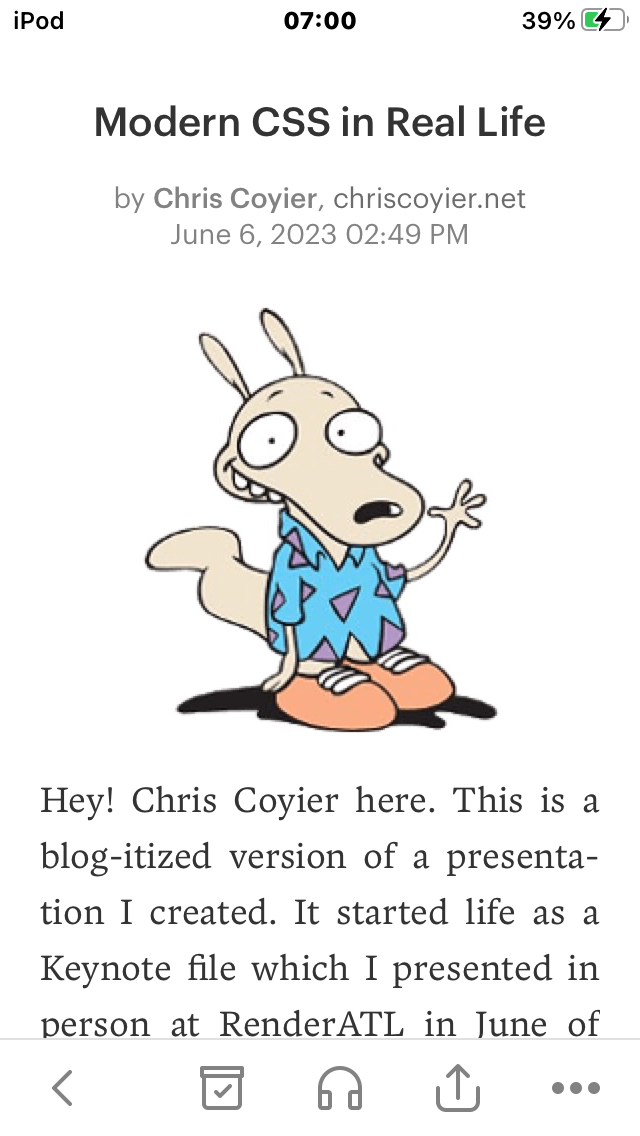
I was trying to read an article by Chris Coyier earlier about Modern CSS which looks to have quite a few things that might be very useful for making my website look a bit more styled. But once again when I sat down later to read the saved article, I got blocked.

I’ve taken some screenshots to illustrate the problem:

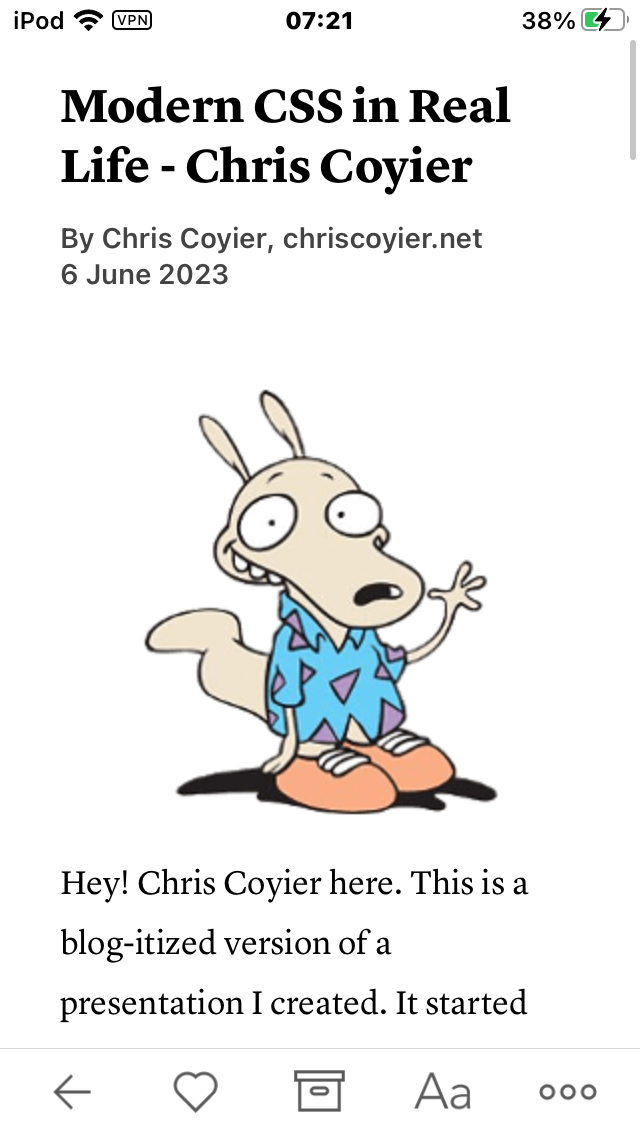
Top of page - Reading Lists
Top of page - Pocket

It starts out pretty good with both Reading Lists and Pocket displaying something that is faithful to the original page. Though notice that Pocket has decided to save it in Article mode, which is essentially a stripped down version of the page, with most styling removed. That apparently saves storage space, but it also makes all pages you save look the same.

That’s not a show stopper much of the time, but kind of ruins the vibe. It’s way nicer to see the actual page you were looking at. And in fact sometimes it is a show stopper, especially for web development articles, because authors tend to often reference their own site when describing various techniques they have used - “Check out the header for an example of that”.

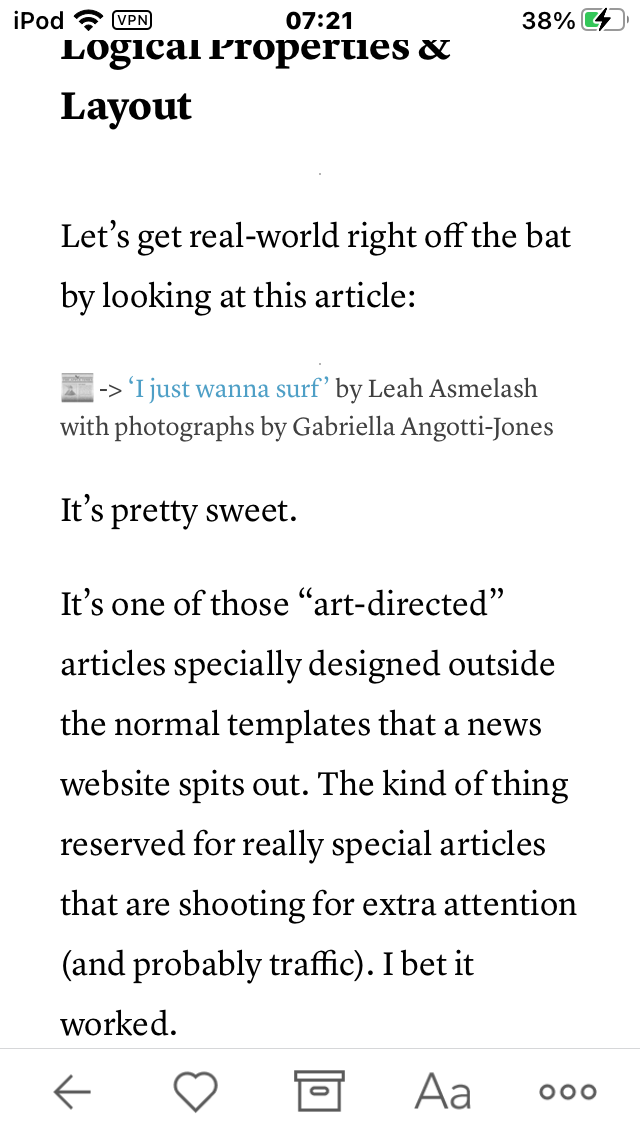
Logical Properties & Layout - Reading Lists
Logical Properties & Layout - Pocket

Things deteriorate quickly though. We get to one of the first major sections, one about Logical Properties & Layout in Reading Lists, and all the images have been disappeared. That's a massive show stopper when you are reading an article about CSS. It’s basically impossible to imagine what a web page looks like just from the textual description. You might get a rough idea, but basically it’s already game over at this point in Reading Lists.

Switch over to Pocket and it’s a little better, but not by much. The section image has appeared in the right place, but the image of the website that Chris is commenting on has gone AWOL. So it’s basically game over in Pocket at this stage too. There’s some difference between the two apps, so maybe we can just switch between them? I doubt it, but I really would like to learn some CSS. Let’s continue.

Update: As I write this article, looking back at the Reading Lists version, it appears as though some of the images have loaded, for example the website Chris was commenting on, but many are still missing in the rest of the page. It’s a perfect illustration of the frustrating offline experience, it somehow takes longer to load the images offline than online!

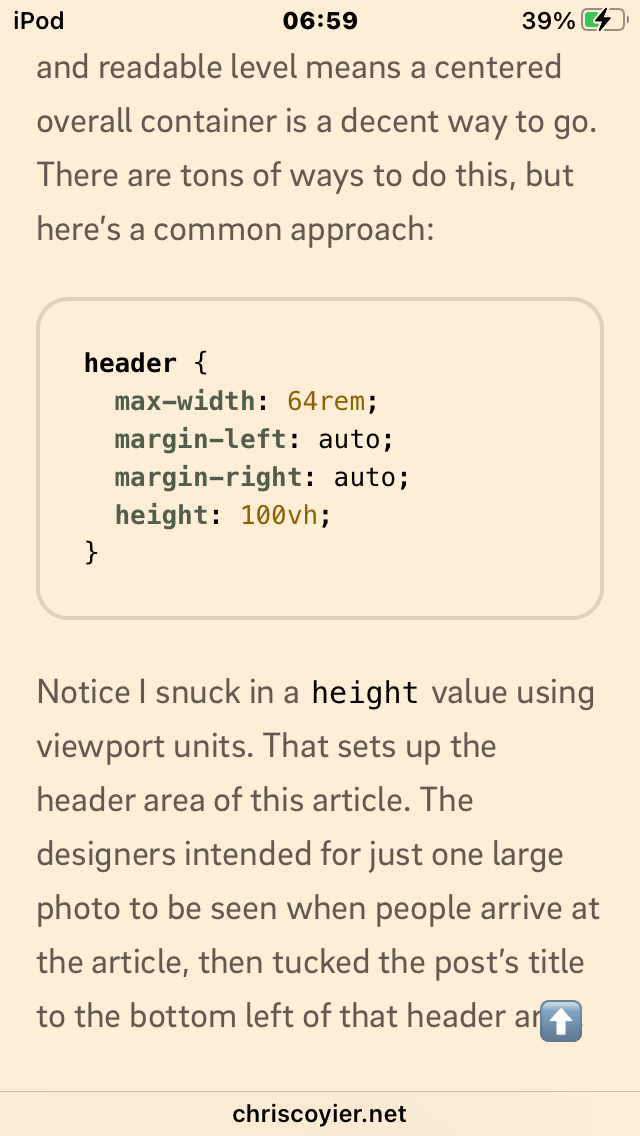
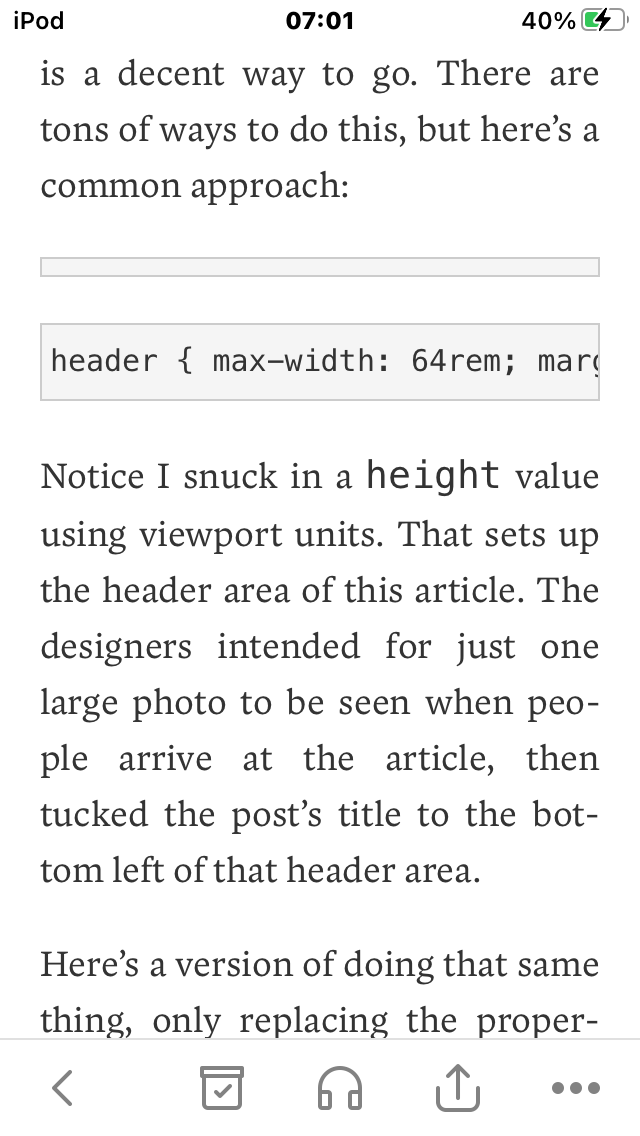
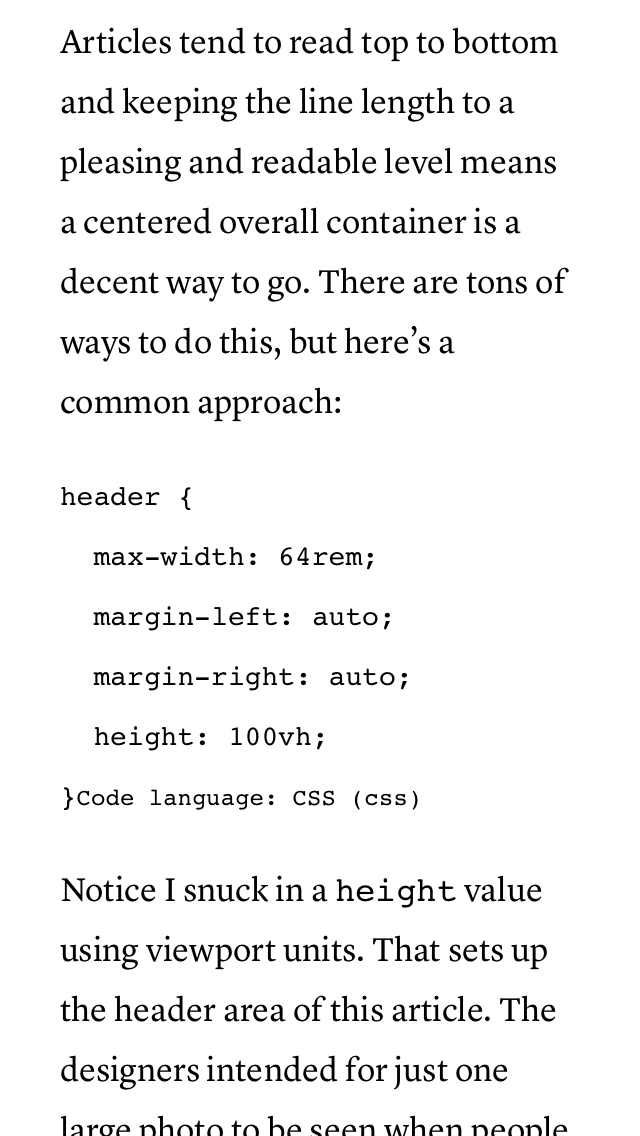
Code Snippets - Reading Lists
Code Snippets - Pocket

Code snippets are looking good in Reading Lists (this time - it’s not always consistent). However in Pocket they’ve been squished down to 1 really long horizontally scrollable line with no syntax highlighting. That’s basically impossible to read and comprehend for anything with moderate complexity.

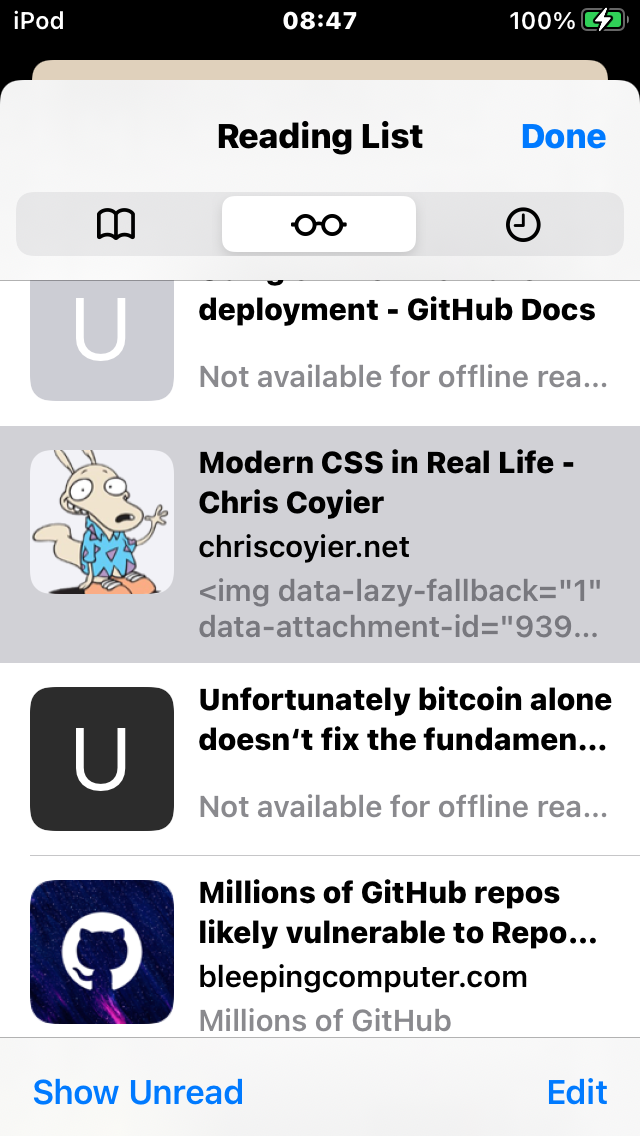
Article listing - Reading Lists
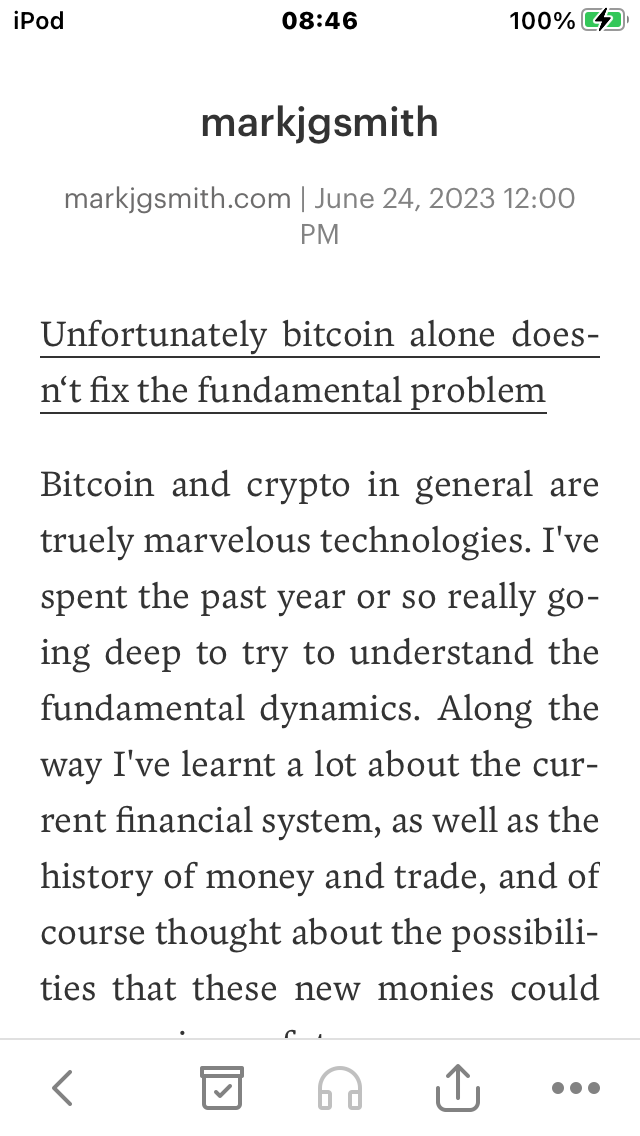
Article page - Reading Lists
Article page - Pocket

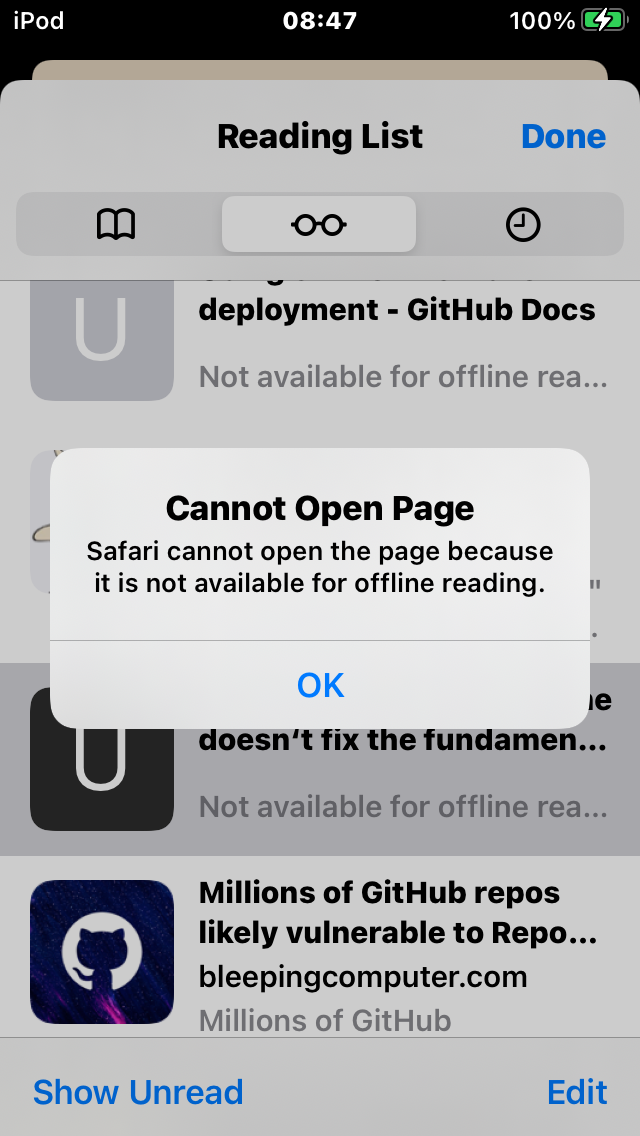
As for article pages, you can see above the 'Top of page' screenshots for Chris’ site. Both look good. But my bitcoin article on Reading Lists results in possibly the most annoying popup in offline reading. That's because it happens so darn often, and always results in a sinking feeling of disappointment. Oh no, not again :(

I could continue with more examples, it’s essentially the same throughout the article. Between the apps there is no way to see screenshots or code snippets. You might get lucky switching between the apps, but probably not, and even if you miraculously did, it would be very difficult to get into flow of the article. It’s much the same for other web development content, such as javascript articles. Reading web development content offline currently is always frustrating and disappointing, if not impossible.

I've been in touch with the Pocket support team. I brought up the following:

  • Since Webview mode fixes the code snippet squashing I asked if it was possible to set it as default. That's not possible and in any case it turns out the Webview mode requires an internet connection
  • If they had a guide on how to structure a webpage HTML for the content and title to be correctly captured by Pocket. No such guide exists, they said that Article view, which is the mode that removes styling, requires websites to be compatible with their parser. They shared a link to a doc that describes Article mode, but it does't have the necessary information

I suspect that I need to modify my HTML in some way, perhaps adding meta tags or just better use of HTML5. I'm left having to figure it out myself using trial and error, not a great result.

Offline needs to be one of the first things we as developers think about. It’s basically progressive enhancement. Not considering it is a recipe for shooting yourself in the foot some time in the future. I’m still looking for a way to have my entire website rendered offline on my iOS device. It happens so often that I need to check something while offline. I read recently about support for webapps on iOS being added, so perhaps I'll look into that at some stage.

2023/06/25

2023/06/24

Unfortunately bitcoin alone doesn‘t fix the fundamental problem

Bitcoin and crypto in general are truely marvelous technologies. I've spent the past year or so really going deep to try to understand the fundamental dynamics. Along the way I've learnt a lot about the current financial system, as well as the history of money and trade, and of course thought about the possibilities that these new monies could open up in our future.

The conclusion that I think I'm reluctantly coming towards is that bitcoin and crypto alone don't solve the fundamental problem, and in fact I think it's very likely they could make it a lot worse. As with a lot of things that are present in so many of the things we do as humans, it's a mixed bag. It could undoubtably make things better in many respects, but at the same time it could make things worse for a lot of people.

The fundamental problem is that people exploit other people

I think the fundamental problem, and I say this knowing it's rather vague, but you have to start somewhere. If I were to put it into words it would be something like - people exploit other people. Of course it's much more nuanced and it's a spectrum with well paid, fullfilling and consentual jobs and businesses on one end and really unpleasant things like slavery, entrapment, starvation, thirst and other types of physical and psychological mutilations on the other.

How people treat each other varies enormously. I've travelled to many places around the world, seen and experienced many cultures, and it's abundantly clear to me that the notion that most people are good, is totally incorrect. In some situations, it's the complete opposite. Now whether it's malice or some sort of emergent group behaviour, or a combination, is perhaps something different entirely, however the fact remains that some people are treated horrendously by others.

One way to think about it, and admitedly it's a somewhat crude way of approaching a very complex situation, but I think it's useful nonetheless because you can get a sort of macro sense of what might be happening, is to imagine that people either fix or break other people's lives. Again it's a spectrum, from small breakages to things that are more permanent or even terminal. People can be both fixers and breakers, at the same time even. Life is full of contradiction.

We have to fix much faster than we break

In this hypothetical world of fixers and breakers it's pretty clear that overall the fixing has to happen faster than the breaking, or else eventually everyone and everything will end up broken. You can look at the world at many scales from countries to individual people's lives, but it's sort of the same result. The reality is that we all live on the same planet shaped boat.

Current fixing rates are woefully innadequate

You just have to spend a little while speaking with homeless people, or indeed have a brush with homelessness yourself to realise that the fixing rates are woefully inadequate in most places. Supply outstrips demand 99 to 1, yet there's not enough. Yes but all homeless people are drug addicts you might say. Well there might be some truth to that statement, but the question is what circumstances led to that. There are very bad people out there who benefit enormously from thoroughly breaking other people's lives. We aren't talking about lone individuals either, we are talking groups that cement their places in society by ruthlessly oppressing others.

There are also many people in need of help that are sober, and even for them it's an almost impossible existence. Guess what looks like addiction: hunger and thirst. In fact it's basically the same thing, humans are in a sense food and water addicts. Thinking all homless people are drug addicts is not only incorrect but it's basically a death sentence to sober homeless people. And one day you too could be a sober homeless person fighting for your right to survive because others broke your life.

Crypto ups the game by an order of magnitude

The thing with crypto is that it opens up enormous possibilities for everyone. That's great in an evenly ballanced world, but the reality is that people that break other people's lives whether through malice or misguidely thinking they are doing the opposite, are much more active. Much like the dynamics in open source software, there are just more people trying to find exploits (notice the similarity in language) than there are people writting and fixing the software.

That's the current state of affairs, but we are entering a period of rapid change. Crypto technologies could enable great things to happen, lets say it's an order of magnitude change, well if the fixing rates remain the same, then things will necessarily get a lot worse for many. And we aren't just talking about homeless people, or people in developing countries. Think about how many people are stuck in jobs or relationships they want out of. This issue cuts across all parts of the world and through all parts of society. I don't see any evidence that fixing rates got any better in the previous big monetary system change. Moving from gold to fiat money made a lot of things possible, but I would argue that fixing rates didn't increase proportionately.

AI will up the game even more

Remember also that this is happening at the same time as the mass introduction of powerful AI technologies that can analize our collective behaviours in mindboggling detail. That's at least an additional order of magnitude in the technological power available. Oh and guess what, after that it's quantum computing. Yet another order of magnitude.

AI financing is the subject of this week's newsletter, the part about cost curves and training is particulary relevant. Out a bit later today @ 12:45 +07:00:

The Economics of Catching the AI Wave (Issue #120)

In a different world

In a different world, bitcoin and crypto could be truely amazing. Yesterday I had the realisation that if a small amount of people are controlling the supply of fiat money, the equivalent to controlling water spigots, literally starving and thirsting vaste swathes of people, then why not create new monies, new water supplies? Surely it's the moral thing to do.

I imagined a world where there were a multitude of crypto currencies, for different loosely affiliated groups. Coins for scientists, coins for musicians, for people into a multitude of fringe and mainstream hobbies. Initially it sounds like it would be too complicated, but with a bit of imagination it needn't be. You would be able to effortlessly spend all of these from your crypto wallet because all shops would be crypto exchanges, and your wallet would be smart enough, because of AI, to always have enough for what you needed or wanted to do. With integrations with other AI software that would help you manage other aspects of your life, it's not unfathomable to think that it could 'just work'.

And by the way, it really is a small amount of people controlling the spigots, cash money is being created at 7 times the rate than actual humans are being created. That's an indication to the current ridiculous innequality throughout the world. It's so mindboggling that it's difficult to fully comprehend. It doesn't have to be that way though. Things could be a lot better for everyone.

And that's why I'm so conflicted on crypto. I return to the main point of the article. These amazing bitcoin and crypto technologies simply are not enough. IMO the cultural make up of our societies is in a state that could make crypto adoption very dangerous long term, where a class of folks, that remain somewhat in the shadows, have enormous power by ensuring breakages in peoples lives happen faster than they get fixed.

That's the core dynamic that needs to be fixed. Maybe Fiat is the worste money, but until the breakages problem is handled, perhaps it's only the worste money except for all the others.

2023/06/23

2023/06/22

The return of number go up

From the linkblog 2023/06/22:

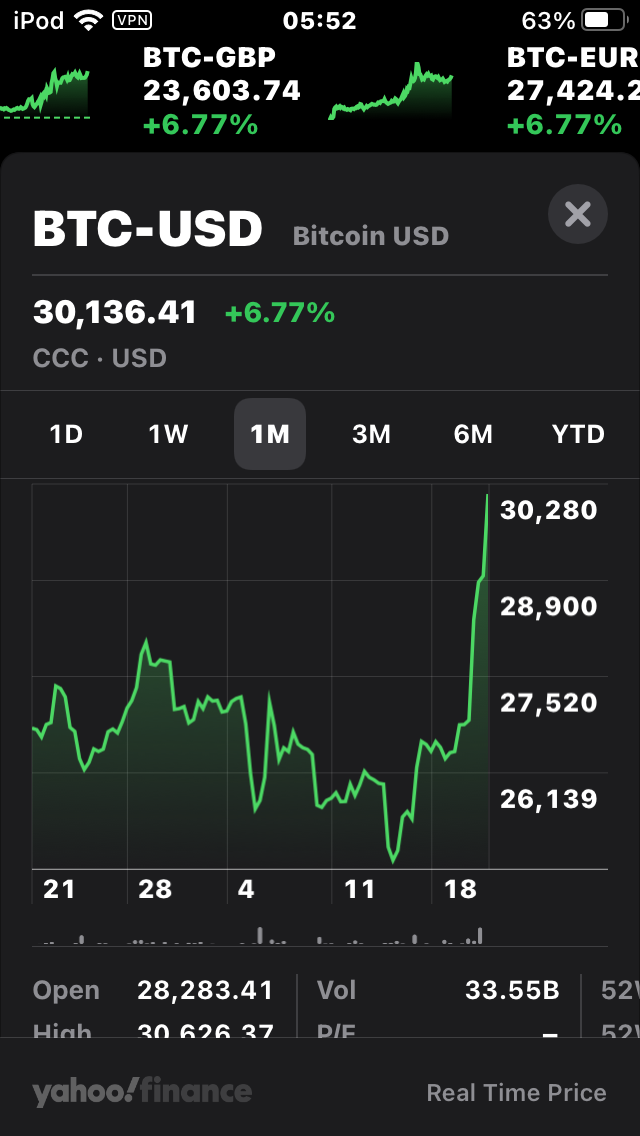
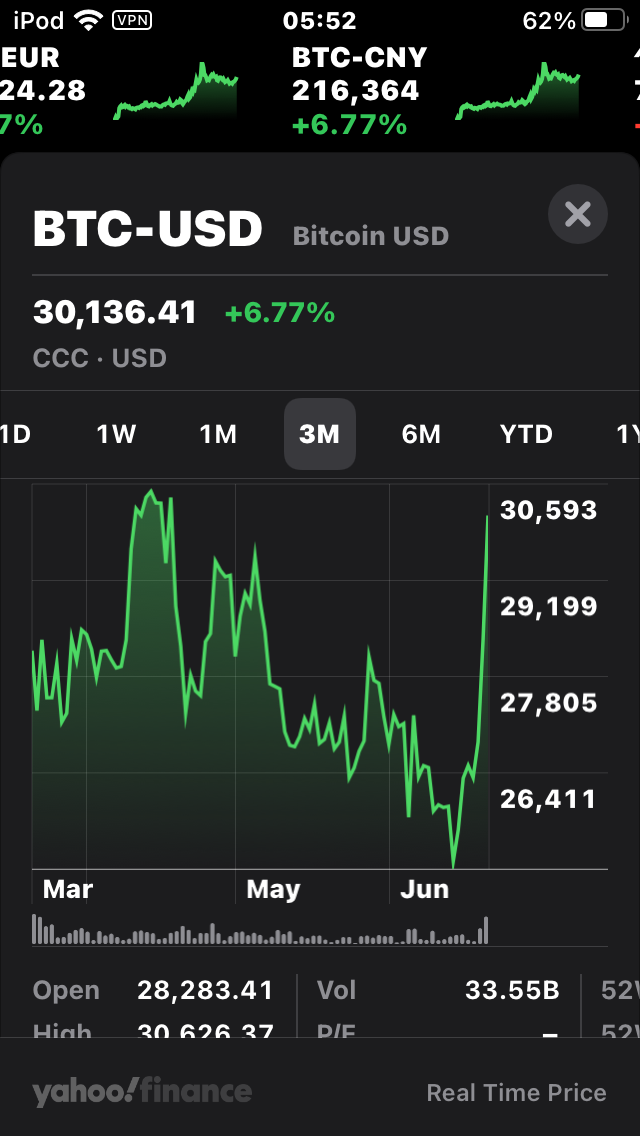
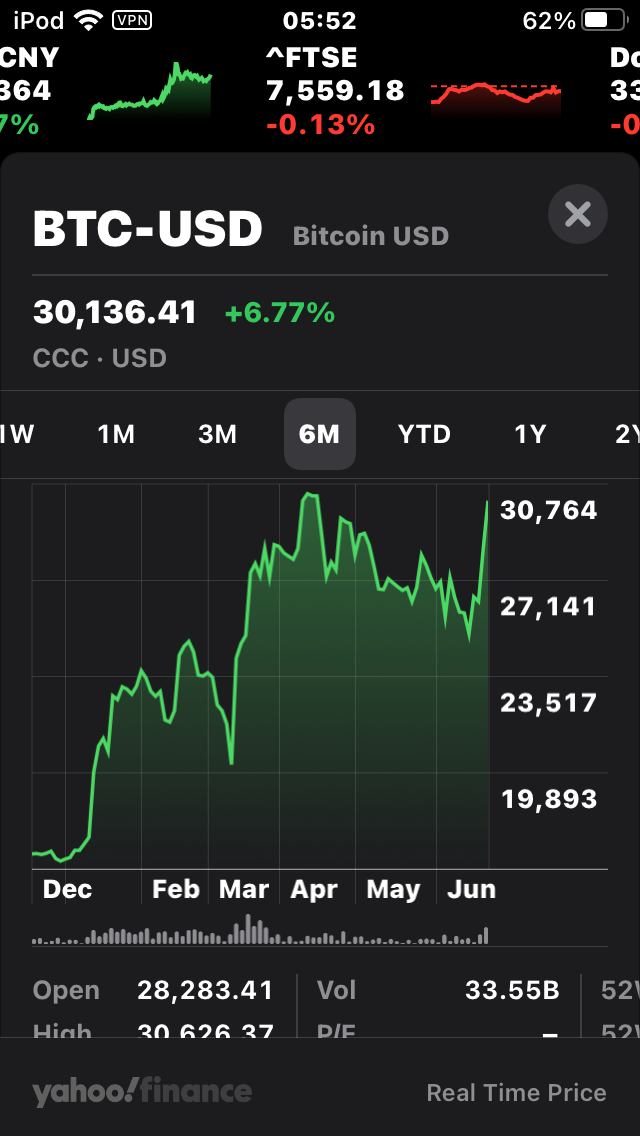
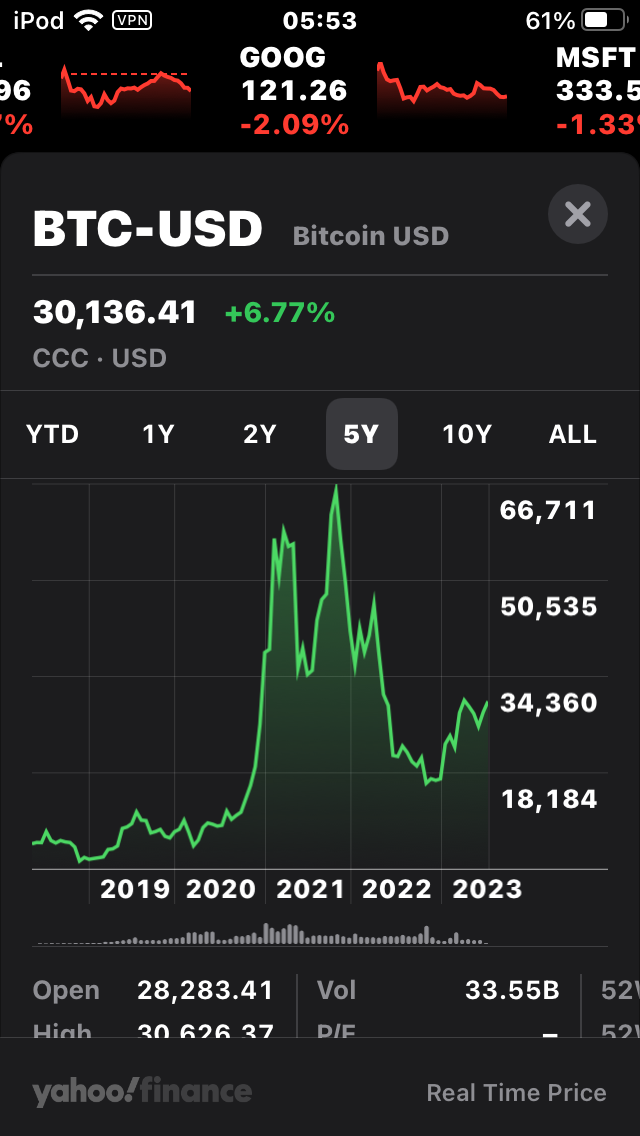
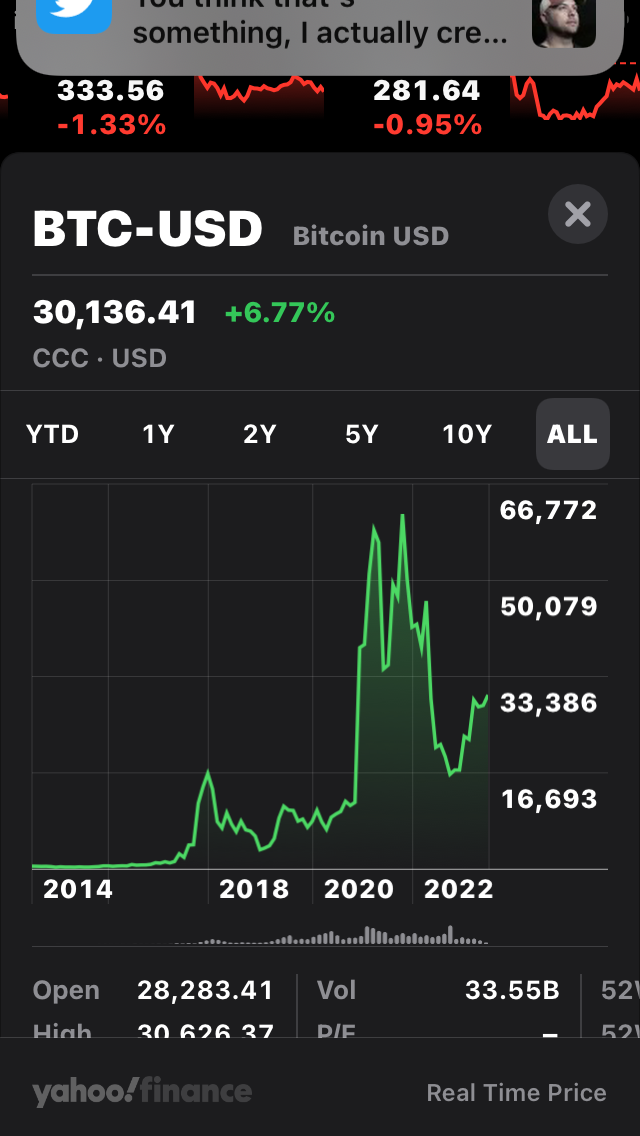
Bitcoin Breaks $28K for the First Time Since May - A flurry of activity in the crypto space has raised the price above $28k, up from 22k in just a few days. It appears to be in response to the world's largest asset management firm Blackrock's announcement of the first Bitcoin ETF, which would open up the possibility of investing to many that previously would not have been able to. Previous to this, it had been a slow and steady decline in price, which appeared to be following the general sentiment that the economy is heading into a deflationary period. This comes at the same time as US regulators have been charging big crypto exchanges for handling unregistered securities, and prominent TradFi figure John Stark has been straightup advising folks to 'get out of crypto' because of the storm brewing and major podcasters in the space are predicting big regulatory headwinds. Nevertheless at least for now, it's the return of number go up.

I thought the graphs were pretty interesting given all the background. Here they are:

Bitcoin return of number go up - 1 month
Bitcoin return of number go up - 3 month
Bitcoin return of number go up - 6 month
Bitcoin return of number go up - 5 year
Bitcoin return of number go up - all time

2023/06/21

2023/06/20

2023/06/19

2023/06/18

2023/06/17

2023/06/16

Fragments of Capital FX

If you have been reading the blog or newsletter for a while, you'll know that I'm a big fan of podcasting. I've been listening to podcasts since the medium started in the early 2000s. I'm always reading about the developments in the industry with a curious eye. A recent pivot by Spotify that I read about really reminded me of my time working in the VFX industry, there are a lot of similarities in how that unfolded.

With a hint of nostalgia in my sails, I went looking for Capital FX, my old company, online and was suprised to find there weren't that many traces remaining. This post is a compilation of some of the fragments I found during my search.

It's not that suprising that there wasn't much remaining. It was a different time back then. The internet wasn't so ubiquitus. Sure we had the web, but mostly that just meant being able to send email, looking up company addresses and perhaps reading the news on the BBC website every now and then. Social media wasn't a thing yet. Facebook was only just starting to get popular at about that time. The idea of having an internet presence was totally foreign to basically everyone. Why would you want to tell everyone about the cash cow you had built? To most normal people that actually seemed like a rather stupid idea. You would occasionally put out press releases, but many of the publications that published those have since gone offline.

First a bit of background info. Capital FX was a feature film post production house specialising in special effects, digital intermediate, and later, digital cinema. I worked there from around 2005, building out the infrastructure as the company grew rapidly in size, taking on increasingly large high profile Hollywood blockbuster projects. The guys that started the company were, in a lot of ways, film production pioneers. They provided various services to film makers, most important and lucrative of which was foreign language versioning. They started small but quickly became central in London's cottage feature film industry.

Capital FX was acquired by Deluxe in 2006, and I continued to work there until 2008. It was a very interesting time to be there, because the entire industry was transforming to fully digital pipelines, from capture to theatre, but we were also dealing with movies shot on old school film. We worked on hundreds of movies, some of which are listed in IMDB. The aquisition was particulary interesting because we suddenly had access to other Deluxe properties including world famous digital intermediate EFilm. We worked closely together to build precission transatlantic production workflows that were used on films such as Children of Men, and The Golden Compass. Big name directors liked working with us because we had the most advanced equipment in the industry, and we knew how to get large complex jobs done on time at very high quality.

So what remains of Capital FX? Well the website is long gone but I was able to recover the company logo from the internet archive.

Capital FX Logo
Beautiful isn‘t it?

This is perhaps my favorite fragment of all. Look at that beautiful cubist and somewhat brutalist combination of small and big letters. And only 1 color! Imagine the confidence that this little photoshop fill tool special gem inspired as it zipped by on reels being watched on a Steenbeck, or indeed on expensive 4K digital projectors in blacked out colour grading theatres. All the goodie bags we gave to clients had this printed on the side of them. Wonderful. Such memories.

Before moving on to the rest of the fragments in our VFX archeological digg, let's take a short detour to learn about How London became the VFX capital of the world. I think it's important to set the scene a little. Ok now that you are feeling the vibe, lets look at the rest of the pieces that I was able to recover. I have also included links to internet archived versions of these pages, denoted by [ia].

Company info listings

DSG DIGITAL LONDON LIMITED (Companies House Listing - The Company) [ia] - You can see it was previously called Capital FX before the acquisition.

DSG DIGITAL LONDON LIMITED (Companies House Listing - People) [ia] - Some of these folks were the big cheeses so to speak, also features names of folks I used to hear about all the time but didn't actually meet because they weren't actively envolved anymore.

With Capital FX [ia] (IMDb - Sorted by Popularity Ascending) - This one gives you a sense for all the awesome movies we worked on. There were a lot more that aren't listed here. Turns out it's quite difficult to get in the credits, especially when the company that acquires you, in our case that was Deluxe, literally has it's logo at the bottom of about 1/2 of all films. The other 1/2 by the way have rival company Technicolor's logo at the end of the credits.

Capital FX, London (IMDbPro - Client & Contact Info) [ia]

Capital FX (London) (BFI - British Film Institute) [ia]

Capital FX Ltd - CFX - London (4rfv) [ia]

Staff press releases

Shelton, Clarke join London's Capital FX (Screen News) [ia] - We had many people join us as the company grew, it was a very cosmopolitan environment, folks from all over the world.

Tech press releases

Capital FX expands Digital Intermediate Services (TV Technology) [ia] - We built a for hire digital intermediate facility that directors would hire out during their production. We developed workflows where footage was being shot in LA and graded the next day in London, all sent digitally over the internet. The color science to get it all looking the same in all locations was quite complicated.

SAN Speeds Capital FX’s DI process (Infostor) [ia] - So much storage, everytime we setup new petabtyes of storage it would get gobbled up almost immediately.

Capital FX Speeds 2K and 4K Workflow on Major Hollywood Movies Using SGI InfiniteStorage Technology (Markets Insider) [ia] - We had a lot of SGI equipment, very fast very large storage for editing at high resolution. This article has probably the best description of the digital pipeline we built. Such a lot of equipment all pieced together in a few short years all while using the infrastructure at near capacity. Not only did we upgrade the plane's engine while flying the plane, so to speak, but no one had ever really built such an engine before. Using this kind of technology at such scale in the creative industries just hadn't been done before.

Lustre Digital Color Grading System Shines Worldwide (Animation World Network) [ia] - All the color grading software and hardware cost enormous amounts of money.

UK's CAPITAL FX BUYS THIRD FURY FILM RECORDER (Post Magazine) [ia] - We also had many Arrilaser recorders, and of course an Arriscanner which could scan between 4-8 frames per second.

Doremi DCI mastering and playback purchased by Deluxe Digital Cinema (UK Broadcast News - 16/05/2006) [ia] - All the d-cinema stuff was super high security, everything encrypted, very expensive pieces of kit, often required custom workflow integrations.

Case studies

Case study: Archiving the blockbusters at Deluxe [ia] - The tape machines were awesome, basically a giant robot jukebox. So many gigabytes of storage.

That's all the fragments I found, there's likely more out there. I remember looking about 4-5 years ago and there was a lot more. So many things on the internet eventually disapear, that's why I wanted to capture a bit of a snapshot now of Capital FX, the pioneers of digital intermediate, visual effects and digital cinema. It was tremendously fun working there!

2023/06/15

2023/06/14

2023/06/13

2023/06/12

2023/06/11

2023/06/10

2023/06/09

2023/06/08

2023/06/07

2023/06/06

2023/06/05

2023/06/04

2023/06/03

2023/06/02

Organising my RSS feeds

One of the items that's been on my todo list for a couple of weeks now is to organise my RSS feeds. I've been tidying them up best I can in short bursts here and there, but I'm struggling, feels like I'm walking up an escalator that's going the other way. It never feels like I'm making much progress.

Feedly has been my app of choice for many years now. The interface is pretty good, there are some nice features. I have the iOS app, and it works quite well, but the one thing it doesn't do well, or at all, is offline. When I'm offline, the app opens but it's just an empty screen, no way to do anything. I find the best time to catchup on RSS feeds is when offline so that's not very practical.

I had a bit of a look for some feed readers in the App Store and found one called Newsify. It's quite good, even offers to login using my feedly account so I was up an running quite quickly, no need to export and re-import feeds. I configured it so the articles appear in a compact way, and the reading experience is relatively good.

All the articles get re-formatted so they all look the same no matter which website you are reading. That's sort of annoying. I know it probably saves a bunch of bandwidth, but I really like to read from the website in question. Striping out all the styling kind of ruins the vibe.

Couldn't there be an option to fetch the actual published web page and store it similar to how Safari Reading Lists work? Surely in this day and age that would be possible. Looks like I'm able to re-organise my feeds in Newsify, though I haven't tried that yet.

I think though what I'd like to be able todo is to manage my feeds in the same way I manage my blog, linkblog, podcast and newsletter data. I just want to add a feeds folder in my data repo and have a markdown file for each feed. Then I could build one or several OPML subscription list files which I would host on my website. I'd like to be able to import that into whichever feed reader I was using. That way I can easily try out new readers. Maybe even try using the feeds in some app I could build myself sometime in the future.

The biggest show stoppers:

  1. Feed readers only seem to support OPML files for bulk import, not for dynamically getting the list of feeds
  2. The OPML file would need to be public, or if basic auth could be supported by the reader app, how do I add authentication to the static files I host on Netlify?

Maybe these are solvable issues, but figured I'd write a blog post about it. If you know any solutions that could help, please email me, I'll write up the setup if I manage to get it working :)

Btw, here's an example OPML file that lists the feeds on this website.

2023/06/01

When will AI start to affect macro?

The world of AI is moving at such a huge pace at the minute and it seems to be accelerating. ChatGPT started it all off with it's chat based interface, and we were all blown away with what it was able to do.

Shortly after that people started to create multi-step versions of these types of applications that can use external tools to retrieve and manipulate data. Some of the first use cases for these AutoGPTs are code assistants but they can be used for any task. These AutoGPTs are incredibly powerful, orders of magnitude more powerful than their predecessors.

There are already comprehensive new javascript libraries with which you can build much more than just chat apps. Entire advertising campaigns that previously would have taken months to construct can now be created in minutes. And there's a lot lot more.

And the money is flowing in that direction too. There have been some reports that important venture funds are repositioning away from crypto to so called frontier tech. In fact blockchains and AI are a very good match, with the ability to autonomously spin up wallets and perform very complex chains of activity.

There's also the recent annoucement that Elon Musk's company Neuralink is going to start clinical trials of human computer interactions via brain implants. It might be a good time to seriously consider our right to mental privacy in the age of brain sensing tech, because when you combine some of these technologies, say with something like edge computing, the possibilities for creating unpleasant adversarial environments are very real. Nice income streams you have there knowledge worker, it would be ashame if you were suddenly unable to function. The future is here, and it's going to be crazy weird.

With all that in mind, it's also important to step back and ask how this will affect the wider world. Something that worries me is escalation. We know things in the economy already escalate. To a large extent it's always been this way, you literally can see it in the data. But with AI the occurrences of dynamics of escalation are going to increase significantly. These aren't always bad per say, but I believe they can be, and it could get a lot worse so to speak.

We should start collecting key metrics so we know how things used to be before AI, what the world looked like, what it felt like to live in. We need to be able to see if and how things are being affected at a macro level. Wouldn't that be prudent?

We've also got quantum computing on the horizon, IBM plans to have a 100000 qubit machine operational with 10 years. What will happen when we add that to the mix? Surely it's going to be another step shift.

Big leaps are also being made in nanotechnology, where tiny robots can be sent into the body to deliver medicine in an incredibly targetted way. All very amazing, but the fact is they could also very well be used to deliver harm to people too. We will need to be able to detect things at that level too. Vulnerable populations like the homeless are already targetted with foreign material placed in their food. It could get a lot worse, and when it does, it could happen at scale and very quickly.

Let’s boldly go into the future and explore the possibilities of these new technologies but let’s avoid a multi story car park collapse of humanities’ cultures. Let’s make sure some of the worste outcomes are avoided with a bit of structure in important areas. Remember ultimately we are all in the same earth shaped boat.

What type of data would we need to collect to get some visibility without destroying the very culture and creativity we are trying to protect in the first place?